Chat with us 1
Practical Training Certified Trainers Safer Workplaces

Work at Height Safety Training

Corporate Training in Bangalore, Hyderabad & Pan-India

Work at height is one of the highest-risk activities performed across industries such as construction, infrastructure, oil & gas, manufacturing, warehousing, telecommunications, facility management, power plants, maintenance opera...
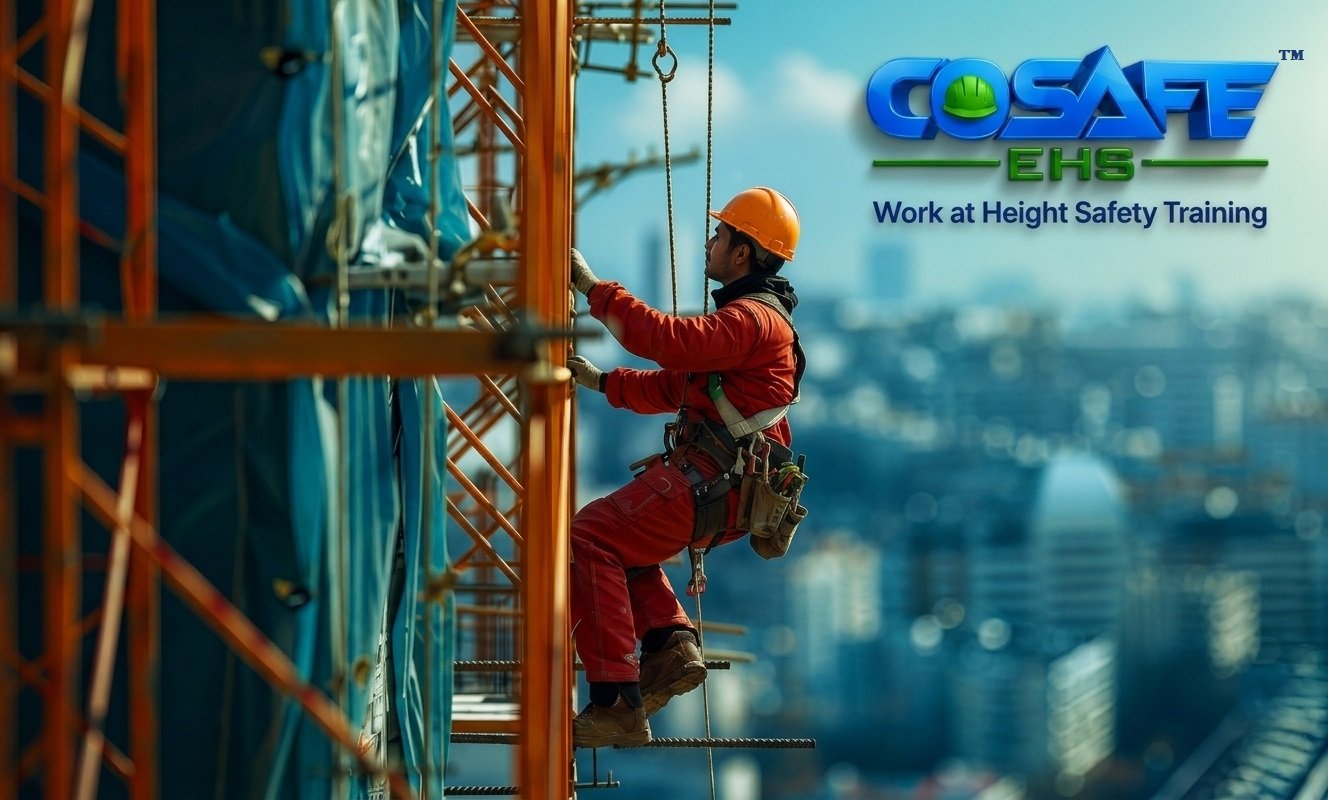
Work at Height Safety Training

Flexible Delivery Options

As per your organizational needs

On-SiteClassroomOnline

Practical & Scenario-Based

Real-life examples, live demonstrations and workplace scenarios

Certificate Provided

Issued to every participant after successful completion of the training

Work at Height Safety Training session

Overview

Work at Height Safety Training in Bangalore & Hyderabad

Work at height is one of the highest-risk activities performed across industries such as construction, infrastructure, oil & gas, manufacturing, warehousing, telecommunications, facility management, power plants, maintenance operations, and industrial shutdown projects. Activities performed on rooftops, scaffolds, ladders, towers, elevated platforms, steel structures, mezzanine floors, and confined elevated workspaces expose workers to severe fall hazards that can result in serious injuries, fatalities, equipment damage, operational downtime, and legal liabilities.

At Cosafe EHS Bangalore & Hyderabad, we provide comprehensive and industry-focused Work at Height Safety Training programs designed to help organizations, contractors, supervisors, engineers, technicians, and workers perform elevated tasks safely while complying with workplace safety standards and industrial best practices. (cosafe.in)

Falls from height remain one of the leading causes of workplace fatalities globally. Safety investigations consistently show that most work-at-height accidents occur because of inadequate training, improper use of fall protection systems, unsafe scaffolding, unstable ladders, poor planning, lack of supervision, weak anchorage systems, unsafe access methods, and failure to identify workplace hazards. Proper work-at-height safety training significantly reduces workplace incidents and improves operational safety performance. (osha.gov)

Work-at-height safety is not limited to wearing a safety harness. It involves proper risk assessment, selection of fall protection systems, safe access planning, inspection of equipment, rescue preparedness, communication, supervision, and compliance with safe work procedures. Organizations that fail to implement proper work-at-height safety systems face increased risks of accidents, project delays, compensation claims, operational losses, and regulatory penalties.

At Cosafe EHS Bangalore & Hyderabad, our Work at Height Safety Training programs combine theoretical learning, practical demonstrations, fall prevention awareness, rescue preparedness, hazard identification exercises, PPE inspection activities, and real-world operational simulations to help organizations build safer workplaces and improve workforce competency. (cosafe.in)

Cosafe EHS Work at Height Safety Training programs are ideal for:

  • Construction and infrastructure companies

  • Industrial maintenance teams

  • Oil & gas operations

  • Telecommunication tower workers

  • Warehousing and logistics facilities

  • Facility management companies

  • Manufacturing and process industries

  • Engineering and fabrication companies

  • Electrical and mechanical maintenance teams

  • Scaffolding and rigging personnel

  • EHS and safety professionals

  • Shutdown and turnaround projects

Organizations that invest in structured Work at Height Safety Training programs improve safety culture, reduce fall-related incidents, strengthen operational discipline, and improve compliance with industrial safety requirements.

Work-at-height activities involve serious workplace hazards that can lead to falls, severe injuries, fatalities, operational disruption, and legal liabilities if not properly managed. Organizations that invest in structured Work at Height Safety Training improve workforce awareness, strengthen operational discipline, reduce workplace incidents, and create safer elevated work environments.

At Cosafe EHS Bangalore & Hyderabad, our Work at Height Safety Training programs empower organizations and employees with practical fall prevention knowledge, hazard identification capability, rescue preparedness awareness, PPE competency, and operational safety practices required to safely perform elevated work activities in modern industrial environments. (cosafe.in)

Prevent Falls. Improve Elevated Work Safety. Build Safer Workplaces with Cosafe EHS Bangalore & Hyderabad.

Enquire Now

Get a customized Work at Height Safety Training proposal for your organization.

Who Should Attend?

All Employees
Managers & Team Leaders
Safety Officers & HR Professionals
Emergency Response Teams
New Joinees
Leadership Teams

Training Modules

Our Work at Height Safety Training program is structured to provide clear understanding, practical insights and real-world examples for better awareness and compliance.

01 Importance of work-at-height safety
02 Common causes of fall-related accidents
03 Understanding fall hazards and consequences
04 Legal and workplace safety responsibilities
05 Roles and responsibilities of workers and supervisors
06 Importance of safe work planning and supervision
07 Identifying work-at-height hazards
08 Fragile surfaces and edge protection awareness
09 Environmental hazards and weather conditions
10 Risk assessment methodologies
11 Unsafe acts and unsafe conditions
12 Hazard control hierarchy and preventive measures
13 Hierarchy of fall protection controls
14 Eliminating and minimizing fall hazards
15 Safe access planning
16 Use of guardrails and barricades
17 Platform and walkway safety
18 Safe positioning techniques
19 Full body harness usage
20 Lanyards and shock absorbers
21 Self-retracting lifelines (SRL) awareness
22 Anchorage points and lifeline systems
23 Harness inspection and maintenance
24 Proper fitting and adjustment procedures
25 Types of ladders and applications
26 Ladder inspection awareness
27 Correct ladder positioning and angle
28 Three-point contact principles
29 Safe climbing practices
30 Ladder storage and maintenance basics
31 Types of scaffolding systems
32 Scaffold inspection awareness
33 Safe access and egress procedures
34 Guardrails and toe-board awareness
35 Scaffold load capacity basics
36 Preventing unsafe scaffold practices
37 Safe rooftop access procedures
38 Fragile roof hazard awareness
39 Edge protection systems
40 Roof anchor systems
41 Weather-related safety precautions
42 Safe movement on elevated surfaces
43 Types of MEWPs and aerial lifts
44 Pre-use inspection awareness
45 Safe operating procedures
46 Fall protection requirements in MEWPs
47 Ground stability awareness
48 Emergency lowering procedures
49 Emergency rescue planning awareness
50 Suspension trauma awareness
51 Fall incident response procedures
52 Emergency communication protocols
53 Rescue equipment basics
54 Coordination with emergency responders
55 Purpose of Permit-to-Work systems
56 Safe work authorization procedures
57 Hazard communication practices
58 Toolbox talk awareness
59 Supervisor responsibilities
60 Worksite safety verification
61 PPE selection for elevated work
62 Helmet and chinstrap awareness
63 Gloves and footwear considerations
64 Harness and connector inspection
65 Limitations of PPE systems
66 PPE maintenance and storage practices
67 Work-at-height compliance awareness
68 Inspection and competency requirements
69 Documentation and reporting basics
70 Safety signage and barricading awareness
71 Worker and supervisor accountability
72 Industry best practices for fall protection management
73 Harness wearing demonstrations
74 Lifeline and anchorage setup awareness
75 Ladder safety practice sessions
76 Fall protection equipment inspection
77 Hazard identification exercises
78 Emergency rescue simulations
79 Work-at-height operational drills

Training Methodology

01
Visual presentations
02
Work-at-height accident case studies
03
Hazard awareness workshops
04
Safety discussions and industrial examples
05
Compliance-focused learning sessions
06
Group-based safety activities
07
Harness inspection and fitting
08
Lifeline and anchorage awareness
09
Ladder safety techniques
10
Scaffold safety basics
11
Safe climbing practices
12
PPE inspection and usage
13
Fall hazard identification exercises
14
Emergency rescue awareness scenarios
15
Unsafe condition reporting activities
16
Work-at-height risk assessments
17
Access control simulations
18
Emergency evacuation drills
19
Team risk assessment activities
20
Toolbox talk simulations
21
Safety communication exercises
22
Emergency coordination drills
23
Leadership and accountability workshops
24
Worker participation activities
25
Exercises include:
26
Fall rescue simulations
27
Harness emergency usage practice
28
Ladder inspection activities
29
Emergency evacuation exercises
30
Work-at-height operational drills
31
Incident response coordination practice
32
Practical fall protection demonstrations
33
Hazard identification exercises
34
Emergency response participation
35
Written assessments and quizzes
36
Scenario-based evaluations
37
Interactive Q&A sessions
38
Industry-focused practical work-at-height training
39
Experienced industrial safety and rescue trainers
40
Realistic fall prevention and rescue simulations
41
Hands-on PPE and fall protection demonstrations
42
Customized programs based on workplace risk profiles
43
Strong emphasis on accident prevention and compliance
44
Multi-industry expertise in workplace safety management
45
On-site and classroom training options
46
Interactive and scenario-based learning methodology
47
Construction & Infrastructure Projects
48
Oil & Gas Industries
49
Manufacturing & Process Industries
50
Warehousing & Logistics Facilities
51
Telecommunication Tower Operations
52
Engineering & Fabrication Industries
53
Power Plants & Industrial Facilities
54
Facility Management Companies
55
Maintenance & Shutdown Operations
56
High-Rise Building Projects

Program Details

Duration

Half Day (3–4 Hours) / Full Day (5–6 Hours)Certification: Certificate provided upon successful completionValidity: 1–2 YearsLanguages: Kannada / Hindi / English / Telugu

Work at Height Safety Training program
Customizable for your organization

Industries We Serve

Our Work at Height Safety Training is relevant for organizations across all industries, including:

IT & ITES
Manufacturing
Healthcare
Education Institutions
Hospitality
Construction & Infrastructure
Logistics & Warehousing
Corporate Offices & All Other Sectors

Why Choose CoSafe EHS?

Experienced Trainers
Customized Training Programs
Practical & Interactive Approach
Flexible Delivery Modes
Industry-Focused Content

Frequently Asked Questions

View All FAQs
Work at Height Safety Training is a specialized workplace safety program that equips participants with the knowledge and practical skills to identify fall hazards, use fall protection systems correctly, perform safe elevated work, and respond effectively to emergencies while complying with workplace safety standards.
This training is ideal for construction workers, engineers, supervisors, EHS professionals, safety officers, scaffolding personnel, riggers, maintenance technicians, telecommunication tower workers, facility management teams, warehouse personnel, contractors, and anyone performing work at elevated locations.
The course covers work-at-height hazards, risk assessment, fall prevention principles, personal fall protection systems (PFPS), ladder safety, scaffolding safety, roof work safety, MEWP safety, rescue planning, Permit-to-Work (PTW), PPE inspection, legal compliance, and practical emergency rescue drills.
Yes. Cosafe EHS provides extensive practical training through harness wearing demonstrations, lifeline and anchorage setup, ladder safety practice, scaffold awareness, PPE inspections, hazard identification exercises, emergency rescue simulations, and realistic work-at-height operational drills.
Work at Height Safety Training is suitable for construction and infrastructure projects, oil & gas industries, manufacturing plants, warehouses, logistics facilities, telecommunication tower operations, engineering companies, power plants, facility management organizations, maintenance teams, and high-rise building projects.
Work at Height Safety Training helps organizations reduce fall-related accidents, improve hazard awareness, strengthen compliance with safety standards, enhance rescue preparedness, minimize operational downtime, protect employees, and build a proactive workplace safety culture.
Yes. Cosafe EHS offers customized corporate Work at Height Safety Training programs for construction sites, factories, warehouses, oil & gas facilities, telecom projects, engineering companies, and industrial workplaces across Bangalore and Hyderabad, tailored to industry-specific operational risks.
Yes. Participants who successfully complete the training program, practical demonstrations, hazard assessments, emergency rescue exercises, mock drills, and competency evaluations receive a Work at Height Safety Training Certificate from Cosafe EHS.
The training includes harness inspection and fitting, ladder safety practice, scaffold safety awareness, lifeline and anchorage demonstrations, fall hazard identification, emergency rescue simulations, work-at-height operational drills, PPE inspections, toolbox talks, and scenario-based safety exercises.
Cosafe EHS provides industry-focused Work at Height Safety Training delivered by experienced EHS professionals and rescue specialists. The program features hands-on fall protection demonstrations, practical rescue simulations, customized corporate training, compliance-focused learning, interactive workshops, and real-world operational exercises to help organizations create safer and fall-free workplaces.

Let's Create a Safer and More
Compliant Workplace Together

Contact us today to get a customized Work at Height Safety Training proposal for your organization.