Chat with us 1
Practical Training Certified Trainers Safer Workplaces

Manual Handling Safety Training

Corporate Training in Bangalore, Hyderabad & Pan-India

Manual handling activities are performed daily across virtually every industry, including manufacturing, warehousing, logistics, construction, healthcare, retail, hospitality, pharmaceuticals, food processing, and office environme...
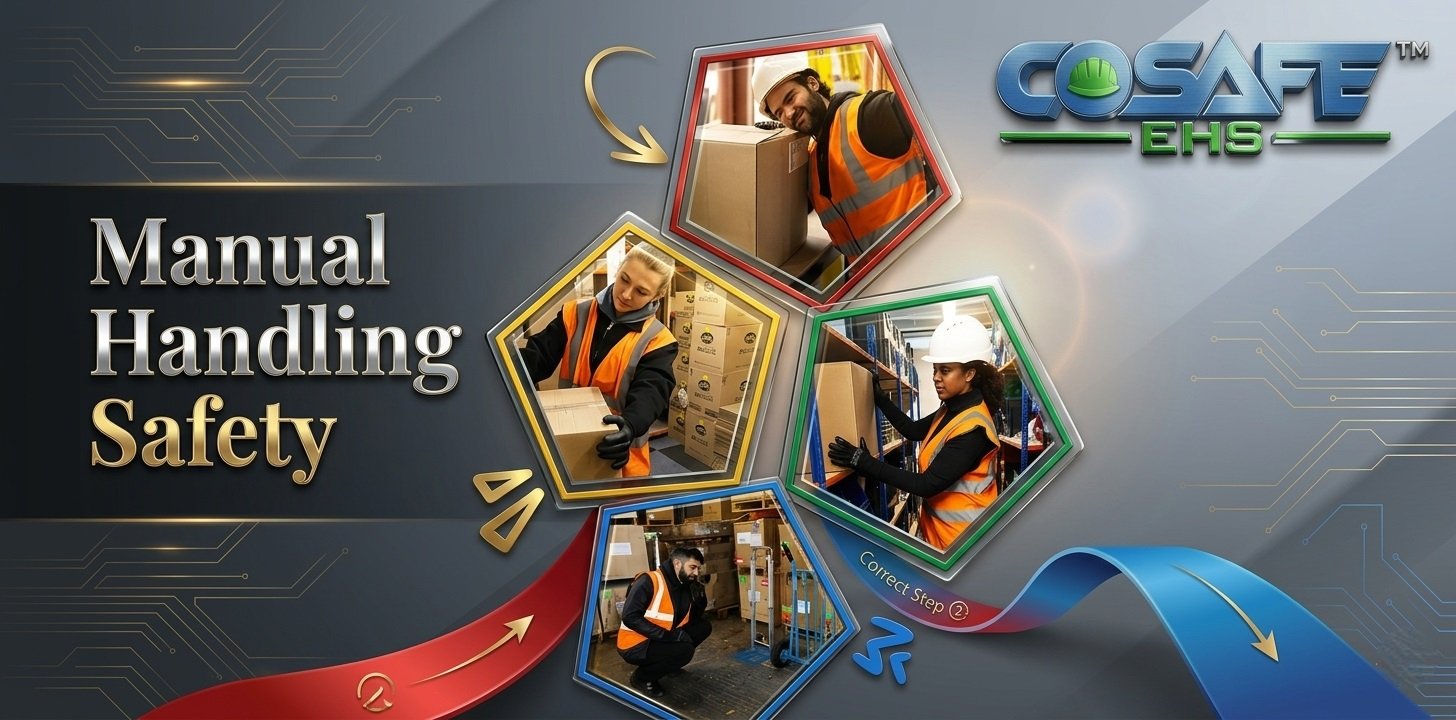
Manual Handling Safety Training

Flexible Delivery Options

As per your organizational needs

On-SiteClassroomOnline

Practical & Scenario-Based

Real-life examples, live demonstrations and workplace scenarios

Certificate Provided

Issued to every participant after successful completion of the training

Manual Handling Safety Training session

Overview

Manual Handling Safety Training in Bangalore & Hyderabad

Professional Manual Handling Safety Training by Cosafe EHS Bangalore & Hyderabad

Manual handling activities are performed daily across virtually every industry, including manufacturing, warehousing, logistics, construction, healthcare, retail, hospitality, pharmaceuticals, food processing, and office environments. Tasks such as lifting, carrying, pushing, pulling, lowering, holding, stacking, moving, and transporting materials are often considered routine; however, they remain one of the leading causes of workplace injuries worldwide.

Poor manual handling practices can result in musculoskeletal disorders (MSDs), back injuries, strains, sprains, shoulder injuries, slips, trips, falls, and long-term occupational health problems. These injuries not only affect employee well-being but also contribute to absenteeism, reduced productivity, increased compensation claims, and operational disruptions.

At Cosafe EHS Bangalore & Hyderabad, our Manual Handling Safety Training Program is designed to provide employees, supervisors, warehouse personnel, healthcare workers, logistics teams, and industrial workers with the knowledge and practical skills required to perform manual handling tasks safely and efficiently. The training focuses on hazard identification, ergonomic principles, risk assessment, body mechanics, safe lifting techniques, and injury prevention strategies.

Our comprehensive training program helps organizations create safer workplaces by promoting proper manual handling techniques, reducing workplace injuries, and improving employee awareness regarding physical risk factors.

Why Manual Handling Safety Training is Important

Many workplace injuries occur because workers underestimate the risks associated with lifting and moving loads. Factors such as awkward postures, repetitive movements, excessive force, poor workplace design, and inadequate training can significantly increase injury risks.

Manual Handling Safety Training helps organizations:

  • Reduce musculoskeletal injuries and disorders

  • Improve employee health and well-being

  • Enhance workplace productivity

  • Strengthen safety awareness and risk management

  • Reduce absenteeism and compensation costs

  • Improve compliance with workplace safety requirements

  • Promote ergonomic work practices

  • Increase operational efficiency

  • Support a proactive safety culture

Improve employee confidence during material handling tasks

Benefits of Manual Handling Safety Training

Organizations that invest in professional Manual Handling Safety Training benefit from:

  • Reduced workplace injuries

  • Improved worker competency

  • Better ergonomic awareness

  • Lower injury-related costs

  • Increased workforce productivity

  • Enhanced safety compliance

  • Improved employee morale

  • Better risk management practices

  • Reduced lost-time incidents

  • Stronger organizational safety culture


Who Should Attend?
This training program is ideal for:

  • Warehouse personnel

  • Logistics and supply chain staff

  • Manufacturing employees

  • Construction workers

  • Healthcare professionals

  • Maintenance personnel

  • Retail workers

  • Material handlers

  • Supervisors and managers

  • Safety officers and EHS professionals

  • Administrative staff involved in handling materials

  • Contractors and support personnel

At Cosafe EHS Bangalore & Hyderabad, our Manual Handling Safety Training combines practical workplace applications with ergonomic best practices to ensure employees can perform tasks safely and effectively.

Manual handling injuries are preventable when workers are properly trained, workplace risks are controlled, and ergonomic principles are applied consistently. Investing in Manual Handling Safety Training is one of the most effective ways to improve employee well-being, reduce workplace injuries, and increase operational efficiency.

At Cosafe EHS Bangalore & Hyderabad, our Manual Handling Safety Training Program equips employees, supervisors, and organizations with the knowledge, practical skills, and confidence required to perform manual handling tasks safely and effectively. Through comprehensive instruction, practical demonstrations, and workplace-focused learning, participants develop the competencies necessary to prevent injuries and create safer working environments.

Lift Smart. Move Safely. Prevent Injuries. Choose Cosafe EHS Bangalore & Hyderabad  for Professional Manual Handling Safety Training.


Enquire Now

Get a customized Manual Handling Safety Training proposal for your organization.

Who Should Attend?

All Employees
Managers & Team Leaders
Safety Officers & HR Professionals
Emergency Response Teams
New Joinees
Leadership Teams

Training Modules

Our Manual Handling Safety Training program is structured to provide clear understanding, practical insights and real-world examples for better awareness and compliance.

01 Definition of manual handling
02 Common manual handling tasks
03 Workplace injury statistics
04 Consequences of poor handling practices
05 Legal and organizational responsibilities
06 Importance of manual handling awareness
07 What are MSDs?
08 Back injuries and spinal health
09 Muscle strains and sprains
10 Joint injuries
11 Repetitive strain injuries
12 Long-term health impacts
13 Early warning signs and symptoms
14 Manual handling risk factors
15 Task assessment techniques
16 Load-related hazards
17 Environmental hazards
18 Individual capability considerations
19 Risk reduction strategies
20 Workplace inspection techniques
21 Principles of ergonomics
22 Neutral body posture
23 Center of gravity awareness
24 Maintaining balance
25 Safe movement techniques
26 Reducing physical strain
27 Workplace ergonomics fundamentals
28 Planning the lift
29 Assessing load weight and stability
30 Proper lifting posture
31 Bending and lifting safely
32 Keeping loads close to the body
33 Avoiding twisting movements
34 Safe lowering techniques
35 Safe carrying techniques
36 Load distribution principles
37 Pushing versus pulling considerations
38 Handling bulky loads
39 Team movement coordination
40 Maintaining visibility while carrying loads
41 When to use team lifting
42 Communication during lifting operations
43 Coordinated movement techniques
44 Shared load management
45 Team lifting hazards
46 Safe handling procedures
47 Trolleys and carts
48 Pallet jacks
49 Hand trucks
50 Lift tables
51 Conveyor systems
52 Mechanical lifting devices
53 Equipment inspection and safe use
54 Storage optimization
55 Workstation design
56 Shelf height considerations
57 Material flow planning
58 Housekeeping practices
59 Reducing repetitive movements
60 Warehouse operations
61 Manufacturing environments
62 Healthcare patient handling awareness
63 Construction material handling
64 Retail stock handling
65 Logistics operations
66 Safety footwear
67 Gloves
68 High-visibility clothing
69 Back support awareness
70 PPE limitations
71 Inspection and maintenance
72 Immediate injury reporting
73 First aid awareness
74 Managing strains and sprains
75 Emergency response procedures
76 Incident investigation awareness
77 Return-to-work considerations
78 Root cause analysis
79 Near-miss reporting
80 Corrective actions
81 Preventive measures
82 Safety observations
83 Continuous improvement initiatives
84 Safe lifting demonstrations
85 Carrying exercises
86 Pushing and pulling techniques
87 Ergonomic assessments
88 Risk assessment workshops
89 Team lifting drills
90 Workplace scenario simulations
91 Participants gain confidence through hands-on practice.

Training Methodology

01
Multimedia presentations
02
Real-world case studies
03
Group discussions
04
Ergonomic awareness sessions
05
Industry-specific examples
06
Best-practice reviews
07
Safe lifting techniques
08
Carrying methods
09
Pushing and pulling practices
10
Ergonomic posture correction
11
Material handling equipment usage
12
Workplace hazard identification
13
Warehouse handling situations
14
Construction material movement
15
Healthcare handling awareness
16
Repetitive task assessments
17
Team lifting exercises
18
Hazard recognition drills
19
Ergonomic assessments
20
Risk assessment exercises
21
Safety observation activities
22
Manual handling planning sessions
23
Team-based problem solving
24
Workplace improvement discussions
25
Written assessments
26
Practical demonstrations
27
Hazard identification exercises
28
Ergonomic evaluations
29
Scenario-based activities
30
Interactive questioning
31
Experienced EHS trainers
32
Industry-specific training content
33
Practical and hands-on learning approach
34
Ergonomics-focused methodology
35
Customized corporate training solutions
36
Interactive workshops and demonstrations
37
On-site and classroom training options
38
Compliance-oriented training programs
39
Competency-based assessments
40
Post-training guidance and support

Program Details

Duration

Half Day (3–4 Hours) / Full Day (5–6 Hours)

Certification

Certificate will be provided after successful completion

Validity

1–2 Years

Languages

Kannada / Hindi / English / Telugu

Manual Handling Safety Training program
Customizable for your organization

Industries We Serve

Our Manual Handling Safety Training is relevant for organizations across all industries, including:

IT & ITES
Manufacturing
Healthcare
Education Institutions
Hospitality
Construction & Infrastructure
Logistics & Warehousing
Corporate Offices & All Other Sectors

Why Choose CoSafe EHS?

Experienced Trainers
Customized Training Programs
Practical & Interactive Approach
Flexible Delivery Modes
Industry-Focused Content

Frequently Asked Questions

View All FAQs
Manual Handling Safety Training teaches employees how to safely lift, carry, push, pull, lower, and move materials using proper body mechanics, ergonomic principles, and risk assessment techniques to prevent workplace injuries and improve operational efficiency.
This course is suitable for warehouse personnel, logistics staff, manufacturing employees, construction workers, healthcare professionals, maintenance teams, retail workers, material handlers, supervisors, managers, contractors, and EHS professionals who perform manual handling tasks.
Improper manual handling can cause musculoskeletal disorders (MSDs), back injuries, strains, sprains, slips, falls, and long-term occupational health problems. Training helps reduce these risks, improve safety awareness, and promote safe working practices.
The training covers hazard identification, ergonomics, body mechanics, safe lifting techniques, carrying, pushing and pulling methods, team lifting, mechanical aids, workplace ergonomics, PPE awareness, emergency response, incident investigation, and practical workplace simulations.
Organizations benefit from reduced workplace injuries, improved worker competency, better ergonomic awareness, lower injury-related costs, increased productivity, stronger compliance, improved employee morale, and a proactive safety culture.
Yes. Cosafe EHS provides hands-on practical demonstrations including safe lifting, carrying, pushing, pulling, ergonomic posture correction, team lifting drills, hazard identification exercises, and workplace scenario-based simulations.
The course teaches participants how to identify manual handling hazards, apply ergonomic principles, use correct lifting techniques, assess risks before handling loads, and utilize mechanical aids to minimize physical strain and prevent injuries.
Yes. Participants learn proper body posture, center of gravity awareness, safe movement techniques, planning the lift, assessing load stability, avoiding twisting, and using safe lifting and lowering methods to reduce injury risks.
Yes. Participants who successfully complete the training program and competency assessments receive a course completion certificate from Cosafe EHS.
Cosafe EHS offers industry-focused training delivered by experienced EHS professionals, practical hands-on learning, ergonomics-based methodologies, customized corporate programs, on-site and classroom training, competency-based assessments, and post-training guidance to help organizations build safer workplaces.

Let's Create a Safer and More
Compliant Workplace Together

Contact us today to get a customized Manual Handling Safety Training proposal for your organization.