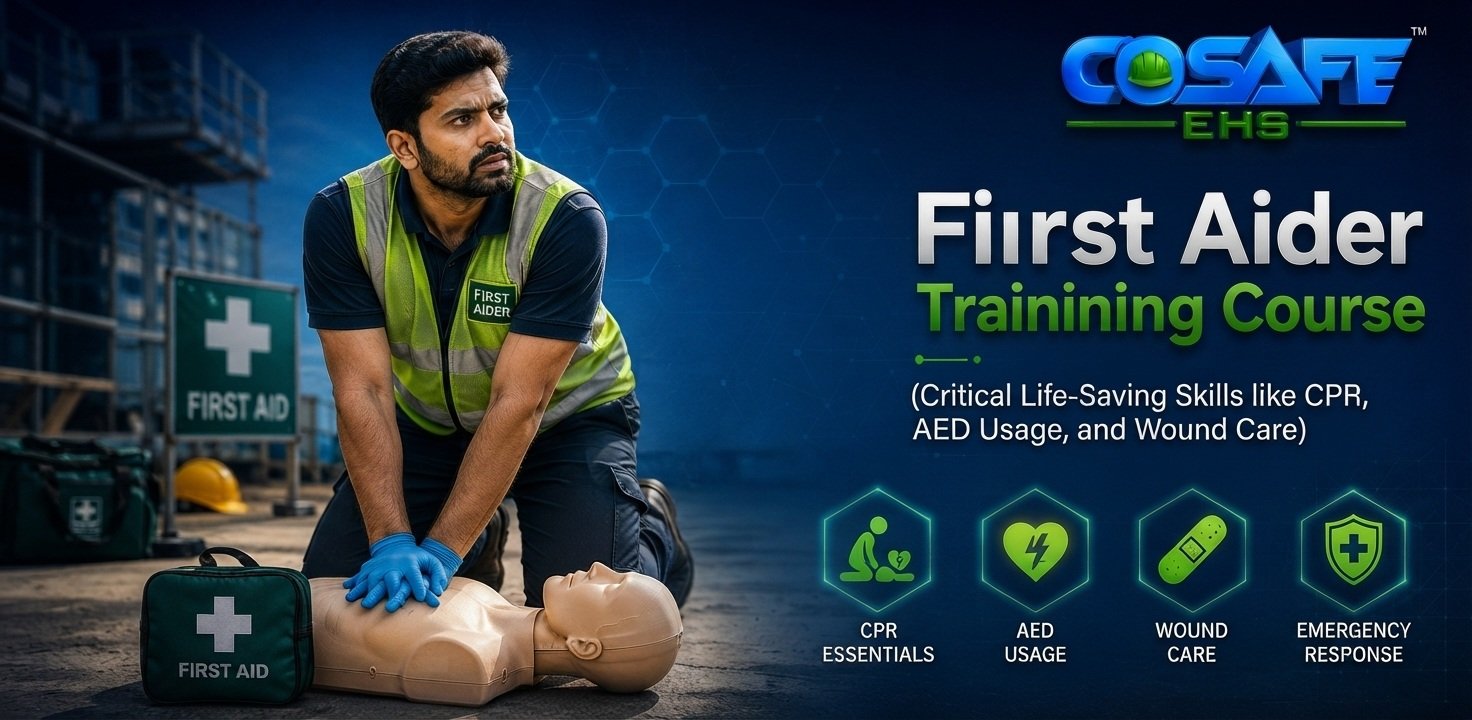
First Aider Course

Duration
3, 6, 12 months
Mode
Online/Offline
Placement
100% assistance
Language
Kannada/Hindi/English

Course Details

First Aider Training Course in Bangalore


Comprehensive First Aid, CPR, AED & Emergency Response Training for Workplace Safety

Medical emergencies can occur at any time and in any workplace, including factories, construction sites, warehouses, offices, hospitals, schools, hotels, shopping malls, logistics facilities, and industrial plants. Cardiac arrest, choking, severe bleeding, fractures, burns, electric shock, chemical exposure, heat stress, and traumatic injuries require immediate first aid before professional medical services arrive. A trained First Aider can make the difference between life and death by providing timely, safe, and effective emergency care.

The Professional First Aider Course by Cosafe EHS Bangalore is a comprehensive, competency-based training program that equips participants with life-saving knowledge, practical emergency response skills, and the confidence to provide immediate assistance during workplace and public emergencies. The course emphasizes hands-on learning through practical demonstrations, CPR practice, AED familiarization, casualty assessment, trauma management, and emergency simulations.

Participants learn internationally accepted first aid principles, including patient assessment, scene safety, Basic Life Support (BLS), Cardiopulmonary Resuscitation (CPR), Automated External Defibrillator (AED) awareness, bleeding control, fracture management, burn treatment, choking response, recovery position, and emergency communication. The program prepares individuals to respond confidently while waiting for professional medical assistance.

What is a First Aider?

A First Aider is a trained individual who provides immediate medical assistance to an injured or suddenly ill person until qualified healthcare professionals arrive. Their responsibilities include assessing the emergency scene, protecting themselves and others, providing first aid treatment, performing CPR when required, controlling bleeding, treating injuries, monitoring casualties, and coordinating emergency medical services.

Why First Aid Training is Important

  • Professional First Aid Training helps organizations:

  • Save lives during medical emergencies

  • Improve survival rates in cardiac arrest through early CPR

  • Reduce the severity of injuries before medical treatment

  • Increase workplace emergency preparedness

  • Strengthen employee confidence during emergencies

  • Reduce workplace downtime caused by incidents

  • Support compliance with occupational health and safety requirements

  • Promote a proactive health and safety culture

  • Improve organizational emergency response capability

Who Should Attend?

This course is ideal for:

  • Safety Officers

  • HSE Engineers

  • First Aiders

  • Fire Marshals

  • Emergency Response Team (ERT) Members

  • Supervisors

  • Managers

  • Construction Workers

  • Factory Employees

  • Maintenance Personnel

  • Electricians

  • Warehouse Staff

  • Security Personnel

  • Facility Managers

  • Healthcare Support Staff

  • Teachers

  • Corporate Employees

  • Hotel Staff

  • Drivers

  • General Public

Industries Covered

  • Construction

  • Manufacturing

  • Oil & Gas

  • Petrochemical

  • Chemical Industries

  • Warehousing & Logistics

  • Healthcare

  • Pharmaceuticals

  • Hospitality

  • Educational Institutions

  • Corporate Offices

  • Aviation

  • Marine

  • Mining

  • Infrastructure

  • Facility Management

  • Power Plants

  • Food Processing


What you'll learn

  • Understand the fundamental principles of First Aid, the responsibilities of a First Aider, scene safety, infection prevention, and the Chain of Survival during medical emergencies.
  • Conduct systematic emergency scene assessments using Primary and Secondary Survey techniques (DRSABCD/DRABC), assess casualties, monitor vital signs, and activate emergency medical services effectively.
  • Demonstrate competency in Basic Life Support (BLS) by performing high-quality Adult, Child, and Infant Cardiopulmonary Resuscitation (CPR) in accordance with internationally accepted emergency response practices.
  • Safely operate an Automated External Defibrillator (AED), including device preparation, pad placement, shock delivery procedures, and post-resuscitation care during cardiac emergencies.
  • Assess and manage airway emergencies by performing appropriate airway management techniques, placing casualties in the recovery position, and responding effectively to choking incidents in adults, children, and infants.
  • Control external bleeding, manage wounds, apply appropriate dressings and bandages, and provide initial treatment for fractures, dislocations, sprains, strains, burns, and other traumatic injuries.
  • Recognize and provide immediate first aid for common medical emergencies, including heart attack, stroke, seizures, asthma attacks, diabetic emergencies, poisoning, heat-related illnesses, electrical injuries, and shock.
  • Apply workplace emergency response procedures by communicating effectively, coordinating with Emergency Response Teams (ERT), documenting incidents, and supporting casualty evacuation until professional medical assistance arrives.
  • Demonstrate practical competency in casualty handling, emergency simulations, CPR, AED operation, bandaging, splinting, patient assessment, and team-based emergency response through hands-on practical exercises.
  • Develop the confidence, leadership, and life-saving skills required to respond quickly and effectively to workplace and public medical emergencies, improving casualty survival, reducing injury severity, enhancing regulatory compliance, and strengthening organizational emergency preparedness across construction, manufacturing, healthcare, oil & gas, logistics, hospitality, education, and industrial sectors.