Fire Marshal Course

Duration
3, 6, 12 months
Mode
Online/Offline
Placement
100% assistance
Language
Kannada/Hindi/English

Course Details

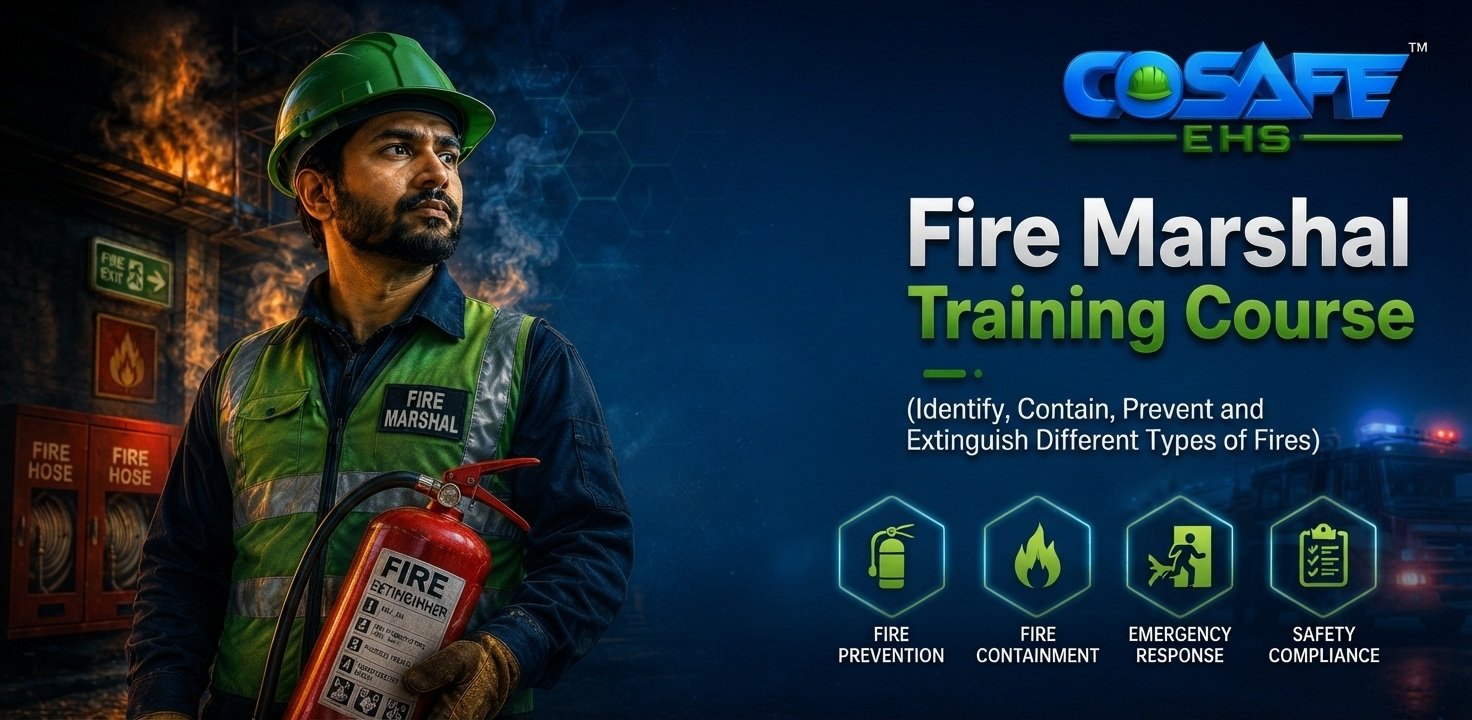
Fire Marshal Training Course in Bangalore


Professional Fire Marshal & Emergency Response Training for Workplace Fire Safety and Evacuation Management

Fire emergencies can occur without warning in offices, factories, warehouses, hospitals, hotels, educational institutions, construction sites, shopping malls, manufacturing plants, oil & gas facilities, and commercial buildings. In such situations, a Fire Marshal plays a critical role in preventing fire incidents, coordinating emergency evacuations, assisting occupants, conducting fire safety inspections, and supporting emergency response teams until professional firefighters arrive. A well-trained Fire Marshal significantly reduces the risk of injuries, property damage, operational downtime, and business disruption.
The Fire Marshal Course by Cosafe EHS Bangalore is a comprehensive, competency-based occupational health and safety training program designed to equip participants with the knowledge, leadership skills, and practical experience required to effectively manage workplace fire prevention, emergency response, evacuation procedures, and fire safety compliance.

The course combines instructor-led classroom sessions, practical fire extinguisher demonstrations, fire detection and alarm system awareness, emergency evacuation drills, fire risk assessment workshops, incident command exercises, mock fire scenarios, and emergency communication training. Participants develop the competency to identify fire hazards, coordinate safe evacuations, perform Fire Marshal duties, support emergency response teams, and build a proactive fire safety culture within their organizations.

The training is suitable for organizations across construction, manufacturing, healthcare, oil & gas, petrochemical, logistics, hospitality, educational institutions, commercial facilities, retail, warehouses, infrastructure projects, and facility management, where trained Fire Marshals are essential for emergency preparedness and regulatory compliance.

What is a Fire Marshal?

A Fire Marshal (also known as a Fire Warden in many organizations) is a designated individual responsible for promoting fire safety, preventing fire hazards, assisting during emergency evacuations, checking assigned areas, accounting for personnel at assembly points, reporting emergency information to incident controllers, and supporting the implementation of workplace fire safety procedures.

Why Fire Marshal Training is Important

  • Professional Fire Marshal training enables organizations to:

  • Improve workplace fire prevention and preparedness

  • Reduce the likelihood of fire-related injuries and fatalities

  • Ensure organized and efficient emergency evacuations

  • Strengthen fire hazard identification and risk assessment

  • Improve compliance with workplace fire safety requirements

  • Protect employees, visitors, and company assets

  • Enhance emergency communication and coordination

  • Build a strong fire safety culture

  • Reduce operational downtime and financial losses following fire incidents

Who Should Attend?

This course is ideal for:

  • Fire Marshals / Fire Wardens

  • Safety Officers

  • HSE Officers

  • Emergency Response Team (ERT) Members

  • Facility Managers

  • Building Supervisors

  • Maintenance Supervisors

  • Security Personnel

  • Site Supervisors

  • Construction Supervisors

  • Warehouse Managers

  • Office Administrators

  • HR Professionals

  • Industrial Workers

  • Factory Supervisors

  • Team Leaders

  • School & College Administrators

  • Hospital Staff

  • Hotel & Hospitality Personnel

Industries Covered

  • Manufacturing

  • Construction

  • Oil & Gas

  • Petrochemical

  • Chemical Industries

  • Warehousing & Logistics

  • Healthcare & Hospitals

  • Educational Institutions

  • Hotels & Hospitality

  • Shopping Malls & Retail

  • IT & Corporate Offices

  • Power Plants

  • Airports

  • Marine & Shipbuilding

  • Infrastructure Projects

  • Facility Management

  • Pharmaceuticals

  • Food Processing Industries


What you'll learn

  • Understand the roles, responsibilities, and legal requirements of a Fire Marshal in promoting workplace fire safety, emergency preparedness, and evacuation management.
  • Identify fire hazards and conduct effective Fire Risk Assessments (FRA) to eliminate or minimize fire risks in industrial, commercial, and institutional workplaces.
  • Explain the principles of fire science, including the Fire Triangle, Fire Tetrahedron, classes of fire, and methods of fire prevention and control.
  • Inspect, identify, and safely operate various firefighting equipment, including portable fire extinguishers, fire hydrants, hose reels, sprinkler systems, and fire alarm systems.
  • Demonstrate the correct use of portable fire extinguishers by applying the PASS (Pull, Aim, Squeeze, Sweep) technique during practical firefighting exercises.
  • Plan, coordinate, and supervise safe emergency evacuation procedures, including assembly point management, occupant accountability, sweep procedures, and assistance for vulnerable persons.
  • Apply effective emergency communication, leadership, decision-making, and incident coordination skills while supporting Emergency Response Teams (ERT) and fire services during workplace emergencies.
  • Conduct routine fire safety inspections, maintain fire safety documentation, inspect emergency equipment, and ensure compliance with organizational fire safety procedures and industry best practices.
  • Respond effectively to fire emergencies by implementing emergency response procedures, incident reporting, evacuation protocols, and post-incident corrective actions to minimize risks and property damage.
  • Develop the practical competency, confidence, and leadership skills required to perform the duties of a certified Fire Marshal, enhancing workplace fire safety, regulatory compliance, emergency preparedness, and organizational resilience across construction, manufacturing, healthcare, oil & gas, petrochemical, logistics, hospitality, commercial, and infrastructure sectors.