Bangalore Office
Warehouse No 4, Survey No 198/6, Janatha Colony, Dommsandra Bangalore Karnataka 562125

Warehouse No 4, Survey No 198/6, Janatha Colony, Dommsandra Bangalore Karnataka 562125
Godown No 3/C, Survey No. 217, Beside ORR, Shamshabad, R.R. District, Hyderabad, Telangana - 501218
+91 7892978960
corporate@cosafe.in
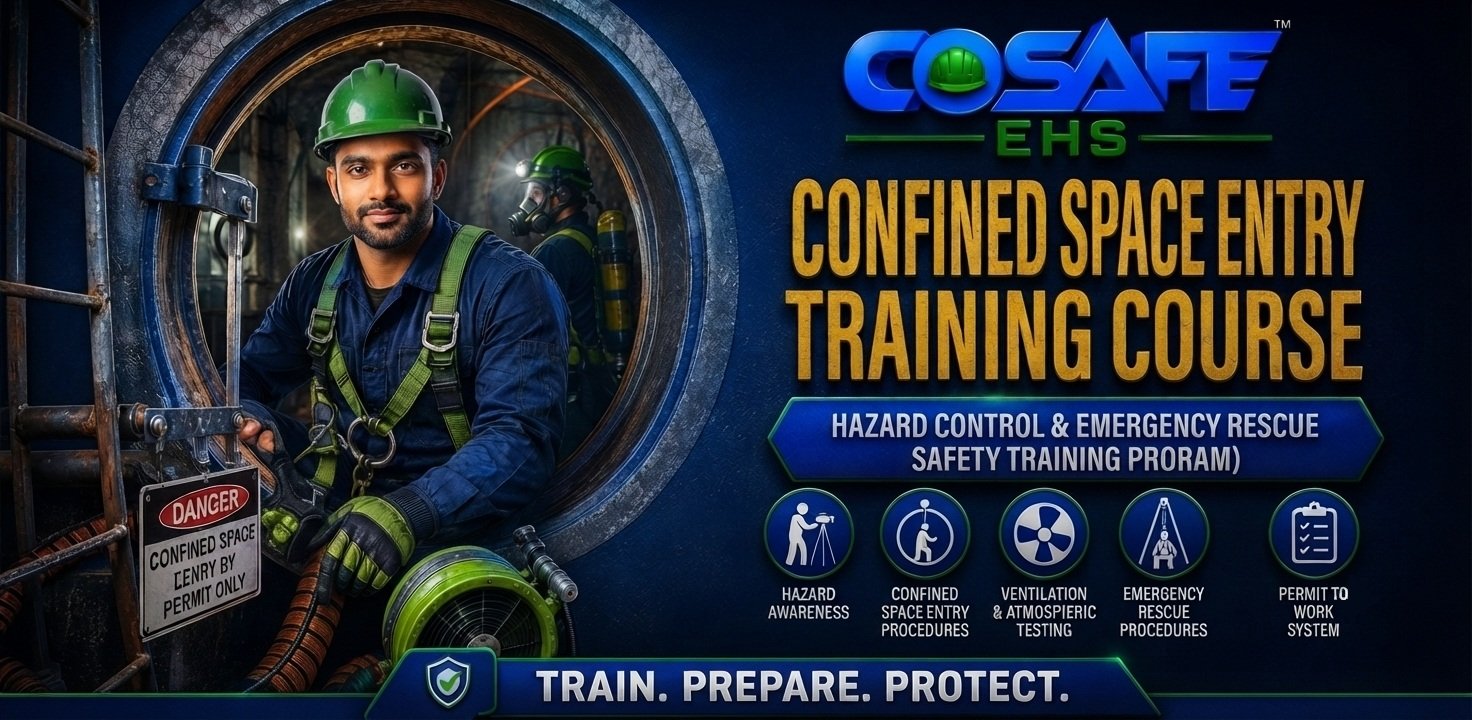
Confined spaces are among the most hazardous work environments in industrial operations. Tanks, silos, storage vessels, manholes, pipelines, sewers, boilers, vaults, pits, tunnels, reactors, sumps, and underground chambers often contain invisible dangers such as oxygen deficiency, toxic gases, flammable atmospheres, engulfment hazards, restricted access, and limited ventilation. Without proper planning, atmospheric testing, permit control, and emergency rescue preparedness, confined space work can rapidly result in serious injuries or fatalities.
The Confined Space Entry Training Course by Cosafe EHS Bangalore is a comprehensive, competency-based occupational health and safety program designed to equip participants with the knowledge, practical skills, and confidence required to safely enter, work within, supervise, and support confined space operations in accordance with recognized industry best practices.
The program combines instructor-led classroom sessions, practical demonstrations, gas detector training, atmospheric monitoring, Permit to Work (PTW) exercises, Lockout/Tagout (LOTO) demonstrations, ventilation techniques, emergency rescue simulations, and realistic confined space entry scenarios. Participants develop the competency to identify confined space hazards, implement effective control measures, conduct atmospheric testing, manage entry permits, use appropriate PPE, and respond effectively during emergencies.
The course reflects internationally accepted confined space entry principles widely adopted across India, UAE, Saudi Arabia, Qatar, Oman, Kuwait, Bahrain, Singapore, Malaysia, Australia, the United Kingdom, Canada, and Europe, making it valuable for professionals working in construction, oil & gas, petrochemical, manufacturing, utilities, marine, and infrastructure industries.
A confined space is an enclosed or partially enclosed area that is large enough for a worker to enter, has limited means of entry or exit, and is not designed for continuous human occupancy. Examples include tanks, vessels, silos, manholes, pipelines, tunnels, pits, boilers, and storage tanks. Some confined spaces are classified as Permit-Required Confined Spaces (PRCS) because they contain or have the potential to contain hazardous atmospheres, engulfment risks, or other serious hazards.
Effective confined space training enables organizations to:
This course is suitable for: