Bangalore Office
Warehouse No 4, Survey No 198/6, Janatha Colony, Dommsandra Bangalore Karnataka 562125



Warehouse No 4, Survey No 198/6, Janatha Colony, Dommsandra Bangalore Karnataka 562125
Godown No 3/C, Survey No. 217, Beside ORR, Shamshabad, R.R. District, Hyderabad, Telangana - 501218
+91 7892978960
corporate@cosafe.in
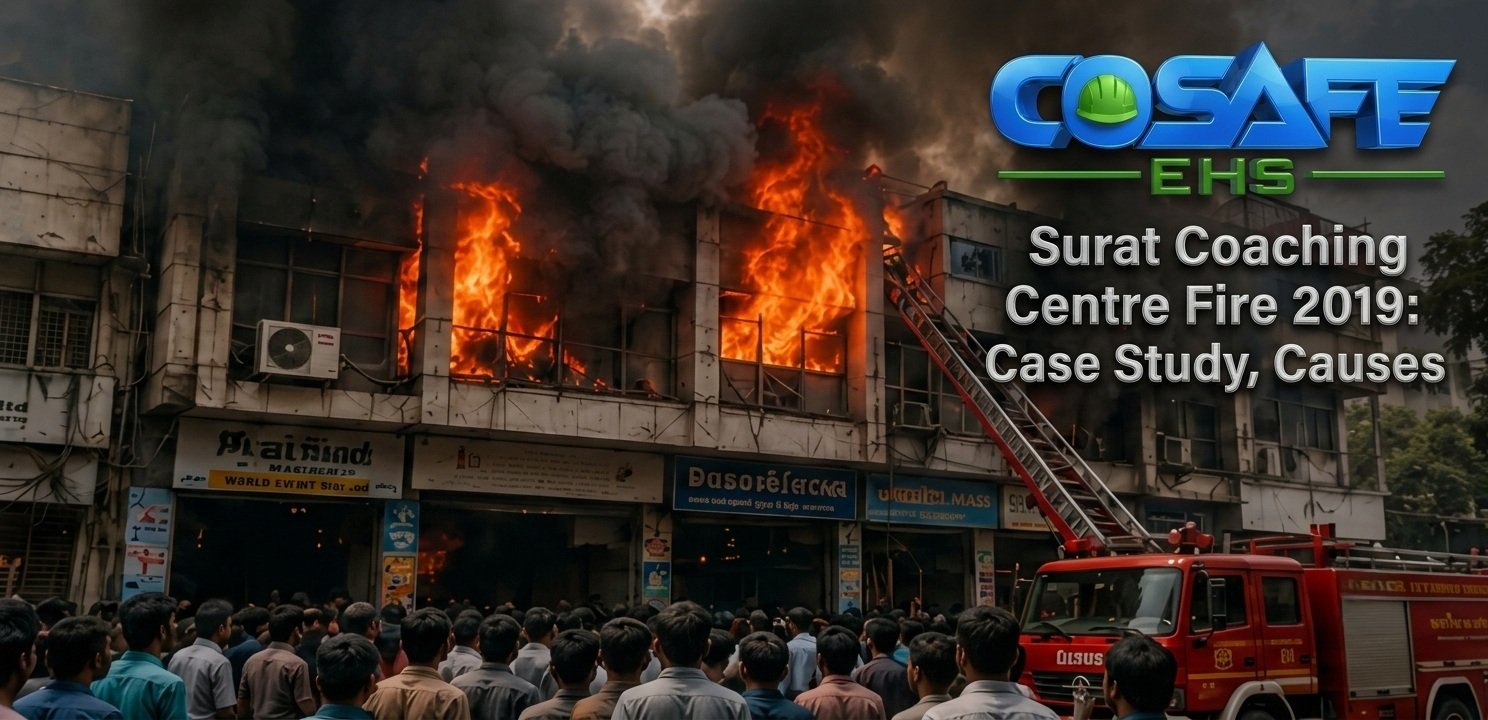
Case Study: Takshashila Arcade Fire, Surat, Gujarat | 24 May 2019
The Surat coaching centre fire remains one of India’s most serious educational-building fire tragedies and a critical case study for schools, colleges, coaching centres, training institutes and commercial educational facilities. This case demonstrates how an electrical fire can escalate into a life-safety emergency when combustible materials, inadequate escape arrangements, deficient fire protection and weak emergency preparedness occur together.
A 2023 impact-assessment report on major Indian fires records that 22 students died in the Takshashila Arcade incident. It states that the coaching centre operated in a makeshift structure on the terrace, that approximately 50–70 students were present, and that students became trapped after the wooden staircase was affected by the fire. Copper India
Important: This is an educational incident-analysis case study prepared from publicly available information. It does not imply that CoSafe EHS was involved in the 2019 incident or investigation.
1. Summary
On 24 May 2019, a major fire occurred at Takshashila Arcade in Sarthana, Surat, Gujarat, where an academic coaching centre was operating on the upper level/terrace of the commercial building. Research reviewed for this case study places the start of the fire at approximately 3:45–4:00 PM. The fire reportedly originated near a rear staircase area, with an electrical short circuit involving an air-conditioning system identified by respondents as the likely initiating event. Copper India
The situation rapidly became catastrophic because the fire was not simply an ignition event. The building contained several interacting risk factors:
The 2023 study records that 22 students died, including deaths associated with smoke/asphyxiation, burns and attempts to escape by jumping from the building. It also records further injuries to students, firefighters and another occupant. Copper India
The tragedy demonstrates a fundamental fire-safety principle: a fire extinguisher alone does not make a building safe. Effective life safety requires an integrated system of prevention, early detection, alarm, compartmentation, protected escape routes, emergency lighting, evacuation planning, trained occupants and competent emergency response.
For educational organisations in Bangalore, Hyderabad and across India, the incident is an important reminder that fire safety must be treated as an operational management responsibility rather than only a statutory documentation requirement.
2. Challenge
Multiple Fire and Life-Safety Failures Occurring Together
The central challenge in the Surat coaching centre fire was the combination of ignition risk, combustible materials, deficient escape arrangements and weak emergency preparedness.
Restricted and Vulnerable Escape Route
Students on the upper level depended heavily on the staircase for evacuation. The study states that the wooden staircase was affected by fire, leaving occupants with very limited time and forcing some students toward the terrace or to jump from the building. Copper India
For any school, college, coaching centre or training institute, escape routes are a critical life-safety control. The important questions are not only whether a staircase exists, but whether:
High Combustible Fire Load
The case-study research identified wooden flooring, wooden fittings, plywood and tyres among the combustible contents in the coaching area. These materials were reported as contributing to rapid fire development. Copper India
Educational institutions frequently contain significant combustible loads including paper, furniture, notice boards, curtains, books, electrical equipment, laboratory materials and decorative elements. Without proper control, a relatively small ignition can develop quickly.
Electrical Fire Risk
The research records an electrical short circuit involving an air-conditioning system as the reported initiating factor. Copper India
Electrical risk becomes particularly serious where there are:
Inadequate Fire Protection
The impact-assessment report states that there was no fire safety equipment in the building and identifies the absence of an emergency exit among the major deficiencies. Copper India
This highlights the need for educational facilities to verify the adequacy and serviceability of appropriate systems such as fire extinguishers, alarms, detection systems, emergency lighting, exit signage, hydrants or sprinklers where applicable.
Weak Emergency Preparedness
A building can have fire equipment but still experience serious casualties when occupants do not know:
This is why fire evacuation mock drills and Emergency Response Team training are essential.
3. Solution
CoSafe EHS Fire Safety and Emergency Preparedness Approach
For organisations seeking to prevent similar failures, CoSafe EHS can apply a structured combination of fire safety training, audits, inspections, emergency planning and mock drills. CoSafe EHS currently lists services including Basic Fire Safety Training, Emergency Response Team Training, Fire Evacuation Mock Drill Training, School Safety Training, Campus/University Safety Training, Fire Safety Audits and Electrical Safety Audits. cosafe.in
Fire Safety Audit
A structured Fire Safety Audit in Bangalore or Hyderabad should evaluate the complete fire life-safety system rather than checking extinguishers alone.
Key areas include:
Electrical Safety Audit
Electrical faults are a significant fire hazard, particularly in buildings with intensive use of air conditioners, computers, laboratories and other equipment.
An Electrical Safety Audit should consider:
Fire Safety Training
Teachers, administrative personnel, security staff, facility teams and selected students should understand basic fire behaviour and emergency actions.
Training should cover:
Emergency Response Team Training
Educational institutions should identify trained emergency personnel with clear responsibilities such as:
CoSafe EHS provides industry-focused practical safety programs and emergency-response training as part of its wider workplace safety offering. cosafe.in
Fire Evacuation Mock Drill
A mock drill should test actual preparedness rather than becoming a routine alarm exercise.
The drill should verify:
Observations should be converted into a corrective-action plan and tracked to closure.
Control of Combustible Materials
Educational facilities should reduce unnecessary fire loading around classrooms, laboratories, staircases and escape routes.
Particular attention should be given to:
Compliance and Building Modification Control
The Surat case also demonstrates why alterations to buildings cannot be treated only as an infrastructure issue. The researched case study records an unauthorized terrace structure and post-incident investigations into statutory approvals. Copper India
Any change affecting occupancy, partitions, staircases, electrical load or escape routes should therefore be subjected to appropriate technical and statutory review before use.
4. Result
Regulatory Response and Lessons for Educational Institutions
Following the tragedy, authorities initiated investigations and wider enforcement activity. The 2023 study records that the Gujarat government ordered private coaching centres to remain closed until fire-safety inspections were undertaken and also called for inspections of schools, colleges, coaching centres, hospitals, malls and other commercial buildings. Copper India
The illegal dome structure at Takshashila Arcade was subsequently demolished by the Surat Municipal Corporation. The Indian Express
The most important result of the case, however, is the safety lesson it provides to organisations today:
Fire prevention alone is not enough. Buildings must also be designed and managed so people can detect danger, receive an alarm, escape safely and be accounted for.
When educational institutions implement a structured fire and life-safety program, the expected outcomes include:
CoSafe EHS follows a structured delivery approach covering need assessment, customised solutions, professional execution, reporting/certification and continued support for safety training, audits and consultancy. cosafe.in
Key Learning
Prevent → Detect → Alert → Evacuate → Respond → Account → Improve
The Surat fire demonstrates that every educational organisation should ask one critical question:
“If a fire starts today, can every person inside detect it, receive the warning and reach a safe place without depending on luck?”
For Fire Safety Training, School Safety Audits, Fire Evacuation Mock Drills, ERT Training, Electrical Safety Audits and Emergency Preparedness services in Bangalore & Hyderabad, CoSafe EHS provides practical, workplace-focused safety solutions for educational and corporate facilities. cosafe.in
Frequently Asked Questions
1. What happened in the Surat
coaching centre fire in 2019?
A major fire occurred at Takshashila Arcade in Surat on 24 May 2019. Students
attending a coaching centre on the upper level became trapped when fire and
smoke affected their escape route. Twenty-two students died. Copper India
2. What caused the Surat coaching
centre fire?
The 2023 case-study report records an electrical short circuit involving an
air-conditioning system as the reported source, followed by rapid fire spread
through combustible materials and the staircase area. Copper India
3. What were the major fire-safety
failures identified in the incident?
Reported deficiencies included inadequate fire-safety equipment, lack of an
effective emergency exit, combustible materials, a vulnerable staircase and
inadequate emergency preparedness. Copper India
4. Why are fire evacuation drills
important for schools and coaching centres?
Mock drills test whether alarms, exits, staff responsibilities, evacuation
routes, assembly points and accountability arrangements actually work during an
emergency.
5. What should an educational
institution fire safety audit cover?
A comprehensive audit should review fire detection and alarm systems, escape
routes, emergency exits, extinguishers, emergency lighting, electrical risks,
combustible materials, evacuation arrangements, emergency-team readiness and
applicable compliance requirements.
6. Does CoSafe EHS provide fire
safety training and audits in Bangalore and Hyderabad?
Yes. CoSafe EHS lists fire safety training, ERT training, evacuation mock
drills, school and campus safety training, fire safety audits, electrical
safety audits and related EHS consultancy among its services.
"Fire prevention alone is not enough. People must be able to detect danger, receive an alarm, escape safely, respond effectively, and be accounted for."
- Surat Coaching Centre Fire 2019: Causes, Root Cause Analysis, Safety Failures & Key Lessons for Fire Prevention
The Takshashila Arcade Fire in Surat, Gujarat, on 24 May 2019 remains one of India’s most important educational-building fire safety case studies. The incident occurred at a coaching centre operating on the upper level of a commercial building and resulted in the deaths of 22 students. The case highlights how an electrical short circuit can escalate into a major life-safety emergency when combustible materials, vulnerable escape routes, inadequate fire-protection systems, and weak emergency preparedness exist together.
The blog examines critical failures including combustible wooden materials, a fire-affected staircase, inadequate alternative escape arrangements, lack of effective emergency exits, insufficient fire-safety equipment, and poor occupant preparedness. It also explains why electrical safety audits, fire safety audits, emergency response training, evacuation planning, and mock drills are essential for schools, colleges, coaching centres, and other educational facilities.
A major lesson from the incident is that having fire extinguishers alone cannot make a building safe. Effective fire and life safety requires early detection, alarms, protected escape routes, emergency lighting, trained personnel, clear accountability, and regular testing of emergency systems.
The case reinforces the need for educational organisations to treat fire safety as an ongoing operational responsibility rather than only a statutory or documentation requirement.
0 Comments
No comments yet. Be the first to comment!