Bangalore Office
Warehouse No 4, Survey No 198/6, Janatha Colony, Dommsandra Bangalore Karnataka 562125



Warehouse No 4, Survey No 198/6, Janatha Colony, Dommsandra Bangalore Karnataka 562125
Godown No 3/C, Survey No. 217, Beside ORR, Shamshabad, R.R. District, Hyderabad, Telangana - 501218
+91 7892978960
corporate@cosafe.in
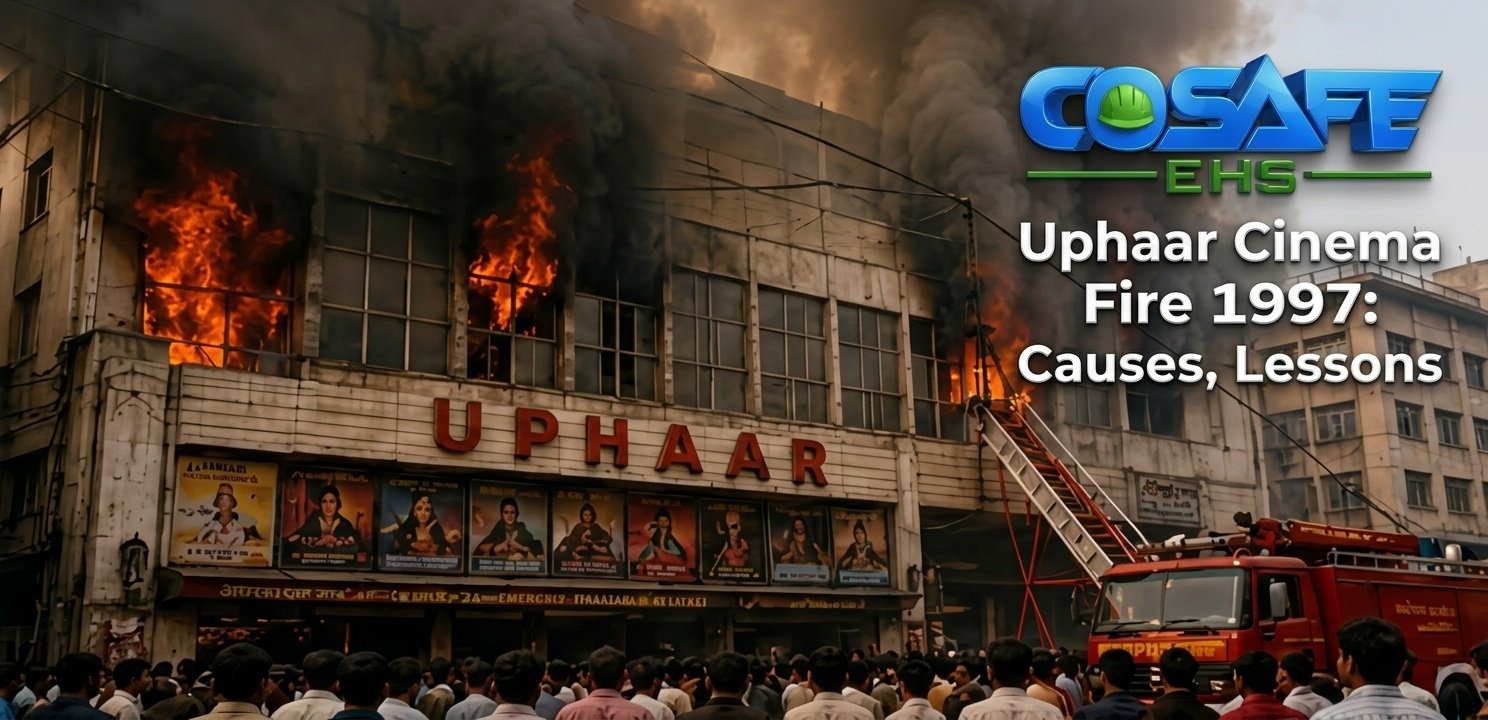
The Uphaar Cinema Fire 1997 remains one of the most important fire-safety case studies in India because it demonstrates how a fire that begins outside an occupied area can become a mass-casualty emergency when smoke movement, electrical systems, evacuation routes, emergency lighting, building modifications, emergency communication and safety management fail at the same time.
On 13 June 1997, a fire involving a Delhi Vidyut Board transformer in the ground-floor parking area of Uphaar Cinema in Green Park, New Delhi, led to the deaths of 59 patrons and injuries to 103 patrons, according to the Supreme Court record. The court record describes how transformer oil, vehicles and combustible materials contributed to heavy smoke generation, while smoke entered the auditorium through pathways including the staircase and air-conditioning ducts.
This case is especially relevant to modern fire safety audits, emergency evacuation planning, fire risk assessment, fire safety training and mock drills. It shows that protecting people from fire is not only about installing extinguishers or firefighting equipment. A safe building also requires properly designed exits, functional emergency lighting, smoke management, communication systems, maintenance, trained personnel and continuous compliance verification.
Important factual correction for the uploaded case-study graphic: the authoritative court record places the major fire incident at approximately 4:55 p.m. during the matinee show, rather than around 12:15 p.m. The matinee screening was of Border. The Supreme Court record confirms the date, location, 59 deaths and 103 injuries.
The Uphaar Cinema Fire occurred at Uphaar Cinema in Green Park, South Delhi, on 13 June 1997.
According to the Supreme Court judgment, a transformer installed by the Delhi Vidyut Board in the ground-floor parking area caught fire shortly after the interval of the matinee screening. Transformer oil leaked and spread into the parking area, where parked vehicles were located. Burning transformer oil, vehicle fuel and other materials generated a large volume of smoke and poisonous gases.
The ground-floor parking arrangement played an important role in how the smoke moved. The Supreme Court record states that the parking area was enclosed and that smoke travelled toward the staircase leading to the balcony. It also moved through air-conditioning ducts into the auditorium, where smoke and toxic fumes accumulated, particularly in the balcony area.
When the building's electricity supply was interrupted, emergency visibility and evacuation became more difficult. Court records and the National Institute of Disaster Management account also describe deficiencies involving emergency lighting and exit visibility.
The disaster therefore provides an important lesson in fire and life safety: the danger to occupants can result not only from flames, but also from smoke, toxic gases, darkness, panic, inadequate egress and failures in emergency preparedness.
Understanding the Uphaar Cinema Fire causes requires separating the initiating fire from the conditions that made the incident so deadly.
The primary fire originated in a Delhi Vidyut Board transformer located in the building's parking area.
The National Institute of Disaster Management's account states that an earlier transformer fire had occurred that morning. After repairs, the transformer was re-energized. Later, loose connections and related damage reportedly resulted in sparking and oil leakage, followed by another fire at approximately 4:55 p.m.
The lesson for modern facilities is direct:
Electrical equipment maintenance is a life-safety issue, not simply an equipment-maintenance issue.
Regular electrical safety inspections, thermographic assessments where appropriate, preventive maintenance, load management and verification of repair quality can help identify electrical fire risks before they develop into emergencies.
The transformer fire did not remain isolated.
According to the Supreme Court record, transformer oil spread toward parked vehicles. The resulting fire involved transformer oil, vehicle diesel and petrol, upholstery, paint, chemicals and other materials, producing substantial smoke and poisonous gases.
This illustrates the importance of fire load management.
A modern fire risk assessment should examine:
Reducing combustible loading can significantly limit the potential development and spread of a fire.
One of the most important lessons from the Uphaar Cinema Fire Case Study is that fire safety cannot focus only on visible flames.
The Supreme Court described the movement of smoke from the ground-floor fire toward the staircase and through the air-conditioning ducts into the auditorium. The smoke accumulated in the upper part of the hall, particularly around the balcony.
This explains why smoke management is fundamental to modern fire and life safety.
The Bureau of Indian Standards explains that NBC 2016 Part 4 – Fire and Life Safety addresses the danger posed by fire, smoke, fumes and panic, and includes provisions relating to smoke control, escape lighting, exit signage, air conditioning, ventilation and other life-safety measures.
For commercial buildings, cinemas, malls, hotels, hospitals, schools, factories and offices, a fire safety assessment should therefore examine not only where fire could start, but also:
Where will smoke travel?
Which routes will remain usable?
Can occupants see exit signs?
Will emergency lighting function?
Could HVAC systems spread smoke?
Can smoke enter normally occupied spaces from service areas?
These questions are central to effective building fire safety.
A fire emergency is ultimately a life-safety and evacuation problem.
The court record contains findings and evidence concerning exit arrangements, gangways, emergency lighting, exit visibility and structural deviations at the cinema. Judicial records also discuss changes to the approved seating and circulation arrangements that affected the ability of occupants to escape.
This demonstrates an important principle:
A building may technically have exit doors but still possess a serious evacuation risk when:
This is why emergency evacuation plan, exit route inspection, emergency lighting inspection and fire evacuation mock drills should be treated as operational safety controls rather than paperwork.
One of the strongest lessons from the incident is the importance of maintaining systems that remain available when normal electrical power fails.
The National Institute of Disaster Management records that the power interruption contributed to darkness inside the building, while emergency lighting and clearly marked exits were inadequate.
The earlier Delhi judicial record similarly identified concerns involving emergency lighting, exit/gangway lights and the public-address system.
A modern fire safety audit should therefore verify:
Emergency Lighting → Does it automatically operate during power failure?
Exit Signage → Is it visible from occupied areas?
Public Address → Can emergency instructions be broadcast?
Fire Alarm → Is detection and notification functional?
Emergency Power → Are essential life-safety systems backed up?
Evacuation Communication → Do employees understand who gives instructions?
Technology alone is not enough. Systems need testing, maintenance and documented inspection.
The Uphaar Cinema Fire causes cannot be reduced to a single electrical failure.
The case demonstrates how multiple conditions can combine to create a major disaster.
1. Electrical Fire Risk
The transformer malfunction and subsequent fire initiated the emergency.
2. Fire Load
Vehicles, fuel, transformer oil and other combustible materials increased the intensity and smoke generation.
3. Smoke Movement
Smoke entered occupied areas through building pathways and air-conditioning ducts.
4. Egress Problems
Judicial records describe deficiencies involving exits, gangways and changes to approved arrangements.
5. Emergency Lighting Failure
Loss of normal electricity created severe visibility challenges, with inadequate emergency lighting identified in the records.
6. Emergency Communication
Records identify the non-functioning public-address system as an important evacuation concern.
7. Emergency Preparedness
The event reinforces the importance of trained staff, evacuation procedures and regular drills rather than relying on equipment alone.
The incident can be translated into a modern fire risk assessment framework.
A good assessment should ask four basic questions:
What Can Start a Fire?
Electrical systems, overloaded circuits, transformers, batteries, kitchens, hot work, flammable liquids, machinery and other ignition sources.
What Can Make the Fire Grow?
Combustible storage, vehicle fuel, packaging, interior materials, chemicals, poor housekeeping and uncontrolled fire load.
How Can Smoke and Fire Spread?
Openings, staircases, ducts, shafts, ventilation systems, service penetrations and unprotected pathways.
How Will People Escape?
Exit capacity, travel paths, stairs, exit doors, emergency lighting, signage, alarms, public-address systems, trained wardens and assembly areas.
This approach changes fire safety from reactive firefighting to preventive risk management.
The National Building Code of India 2016, published by the Bureau of Indian Standards, provides a comprehensive framework for building construction and safety. Part 4 – Fire and Life Safety addresses fire prevention, life safety and fire protection.
BIS identifies areas including:
It is important to distinguish the National Building Code as a model code from the applicable enforceable requirements of the relevant state and local authorities. The Ministry of Home Affairs has stated that NBC is recommendatory in nature and that states/UTs and local bodies incorporate its recommendations through their applicable building bye-laws and fire-safety requirements.
For organizations, compliance should therefore be evaluated against the applicable local regulations, approvals, occupancy requirements and fire authority requirements, in addition to relevant NBC provisions.
A comprehensive Fire Safety Audit should go beyond checking whether extinguishers exist.
It should evaluate the complete emergency-safety system.
Fire Prevention
Inspect:
Fire Protection
Verify:
Life Safety
Assess:
Emergency Preparedness
Review:
CoSafe EHS's published workplace fire-audit scope similarly includes electrical fire hazards, fire protection systems, emergency lighting, exit signage, emergency evacuation plans, assembly points, mock drills, training records and fire-safety documentation.
A written emergency plan cannot evacuate a building by itself.
People have to understand what to do.
Effective Fire Safety Training should cover:
Fire Prevention → Recognizing common ignition sources and fire hazards.
Fire Response → Understanding alarm activation, emergency communication and immediate actions.
Fire Extinguisher Awareness → Understanding when firefighting equipment can and cannot be used.
Evacuation → Using designated escape routes without creating additional congestion or panic.
Assembly → Reporting to the correct emergency assembly point.
Emergency Roles → Fire wardens and response teams understanding their responsibilities.
First Aid → Basic emergency medical response and escalation.
Mock Drills → Testing whether procedures actually work under realistic conditions.
CoSafe EHS describes its fire-safety training as combining fire fundamentals, hazard identification, practical response and emergency preparedness for workplaces in sectors such as offices, factories, warehouses, construction sites, educational institutions and commercial buildings.
The lessons from the Uphaar Cinema Fire 1997 can be translated into a practical corrective-action program.
Electrical Safety
Conduct periodic inspection and preventive maintenance of electrical systems, identify overloaded circuits and investigate abnormal heating, sparking or repeated faults.
Fire Load Control
Keep combustible and flammable materials away from ignition sources and maintain suitable storage controls.
Exit Management
Keep all designated escape routes unobstructed and verify that changes in seating, partitions, storage or occupancy do not compromise egress.
Emergency Lighting
Test emergency lights under simulated power-failure conditions.
Exit Signage
Ensure signs remain visible and understandable from relevant occupant areas.
Smoke Management
Assess potential smoke pathways through stairs, ducts, shafts and other building openings.
Alarm and Communication
Test fire alarm notification and public-address systems regularly.
Fire Equipment
Inspect and maintain extinguishers, hydrants, hose reels, sprinklers, pumps and associated equipment according to applicable requirements and manufacturer/authority requirements.
Training
Train employees, security teams, facility personnel and designated emergency responders.
Mock Drills
Run scenario-based evacuation drills and document observations and corrective actions.
Documentation
Maintain inspection reports, maintenance records, training records, drill reports and corrective-action closure evidence.
The tragedy was at a cinema, but its lessons apply to almost every occupied building.
A factory can experience an electrical fire.
A warehouse can experience combustible-storage ignition.
A hospital can face smoke evacuation challenges.
A hotel can face night-time evacuation difficulties.
A school can face high occupant density.
A shopping mall can face complex crowd movement.
An office can lose communication and emergency lighting during a power failure.
Therefore, Fire and Life Safety should be viewed as an integrated system.
The essential question is not:
“Do we have fire extinguishers?”
The more important question is:
“Can every person in the building detect the emergency, understand the warning, find a safe escape route and reach a place of safety?”
That is the real objective of fire safety management.
Organizations can use the following high-level checklist as a starting point for a professional assessment:
|
Fire Safety Area |
What to Verify |
|
Electrical Safety |
Wiring, panels, loading, maintenance |
|
Transformer Safety |
Condition, enclosure, oil leakage, access |
|
Fire Load |
Combustibles, chemicals, storage |
|
Housekeeping |
Waste and combustible accumulation |
|
Fire Detection |
Alarm, detectors, notification |
|
Fire Protection |
Extinguishers, hydrants, sprinklers |
|
Emergency Lighting |
Operation during power failure |
|
Exit Signage |
Visibility and correct positioning |
|
Escape Routes |
Accessibility and unobstructed paths |
|
Staircases |
Safe access and evacuation |
|
Smoke Control |
Smoke movement and ventilation |
|
Emergency Communication |
PA/alarm/emergency contacts |
|
Evacuation Plan |
Clear roles and routes |
|
Fire Wardens |
Training and responsibilities |
|
Mock Drills |
Frequency, performance and corrective action |
|
Documentation |
Inspection and maintenance records |
|
Fire Compliance |
Applicable approvals and requirements |
|
Corrective Actions |
Closure tracking and verification |
The Uphaar Cinema Fire Case Study demonstrates a concept that remains highly relevant to EHS professionals:
Fire prevention must begin before the alarm sounds.
A strong fire-safety program combines:
Risk Identification + Engineering Controls + Compliance + Maintenance + Training + Emergency Preparedness + Mock Drills + Continuous Improvement
Removing only one hazard may not be sufficient. A resilient safety system requires multiple layers of protection.
This is consistent with the structure of NBC 2016 Part 4, which addresses fire prevention, life safety and fire protection as interconnected elements of building safety.
For organizations looking to convert these lessons into an actionable safety program, CoSafe EHS provides practical EHS training, audits and consultancy services covering workplace fire-safety requirements, emergency preparedness and compliance-related risk controls.
Its published Fire Safety Audit scope includes inspection of electrical fire hazards, firefighting systems, fire alarms and detection, emergency lighting, exit signage, evacuation plans, assembly points, mock-drill records, training records and fire-safety documentation.
CoSafe EHS also provides Basic Fire Safety Training Bangalore Hyderabad designed around fire prevention, fire hazards, fire behavior, practical response and emergency preparedness.
For organizations in Bangalore, Hyderabad and other locations, these services can be integrated into a broader EHS management system, including fire safety audits, emergency evacuation drills, risk assessments, safety training and corrective-action monitoring.
Build a safer workplace before an emergency occurs.
CoSafe EHS – Fire Safety Training | Fire Safety Audit | Emergency Preparedness | EHS Consultancy
The Uphaar Cinema Fire 1997 should not be remembered only as a historical tragedy. It should also be studied as a powerful Fire Safety Case Study India for understanding how multiple vulnerabilities can interact during an emergency.
The key lessons are clear:
Electrical systems require preventive maintenance.
Combustible fire loads require control.
Smoke can be as dangerous as flames.
Emergency exits must remain accessible at all times.
Emergency lighting must function when normal power fails.
Communication systems must be operational.
Building modifications must not compromise life safety.
Firefighting systems require inspection and maintenance.
Employees need practical emergency training.
Mock drills must test actual readiness, not simply satisfy documentation requirements.
Fire safety compliance requires continuous verification.
Most importantly, fire safety is a life-safety system, not just a firefighting system.
The objective should always be to identify hazards early, reduce the probability of fire, control fire and smoke spread, provide reliable means of escape, train occupants and ensure that emergency systems work when people need them most.
Frequently Asked Questions
1. What happened in the Uphaar Cinema Fire of 1997?
The Uphaar Cinema Fire 1997 occurred on 13 June 1997 at Uphaar Cinema in Green Park, New Delhi. A Delhi Vidyut Board transformer in the ground-floor parking area caught fire, resulting in heavy smoke and toxic fumes entering the cinema. 59 people died and 103 patrons were injured, according to the Supreme Court record.
2. What was the main cause of the Uphaar Cinema Fire?
The fire originated in a transformer in the ground-floor parking area. Transformer oil leaked and the resulting fire spread to nearby vehicles and other combustible materials, producing large quantities of smoke and toxic gases.
3. Why were so many people affected by smoke?
Smoke travelled from the parking area toward the staircase and through air-conditioning ducts into the auditorium. The Supreme Court record states that smoke and poisonous fumes accumulated in the upper portions of the auditorium, particularly around the balcony.
4. What are the major fire safety lessons from Uphaar Cinema?
Major lessons include maintaining electrical systems, controlling fire loads, ensuring unobstructed exits, maintaining emergency lighting and communication systems, managing smoke movement, training occupants and conducting regular emergency drills.
5. Why are emergency exits important during a fire?
During an emergency, occupants need safe and accessible escape routes. Exit routes can become ineffective when they are blocked, narrowed, poorly marked, inadequately illuminated or affected by smoke.
6. What is the importance of a fire safety audit?
A Fire Safety Audit systematically evaluates fire hazards, fire protection systems, emergency exits, emergency lighting, alarms, evacuation arrangements, training, documentation and other life-safety controls. CoSafe EHS's published audit scope includes these areas.
7. What does NBC 2016 say about fire and life safety?
NBC 2016 Part 4 – Fire and Life Safety addresses fire prevention, life safety and fire protection, including escape lighting, exit signage, smoke control, occupant load, egress and firefighting systems.
8. Is the National Building Code legally applicable everywhere in the same way?
NBC 2016 is a national model code. The Ministry of Home Affairs has stated that it is recommendatory in nature and that states and local bodies incorporate its recommendations through applicable local building bye-laws and fire-safety requirements.
9. Why are fire evacuation mock drills necessary?
A Fire Evacuation Mock Drill tests whether employees know emergency routes, alarms, assembly procedures and responsibilities. It can also reveal practical problems such as blocked routes, poor communication, inadequate signage or delays in evacuation.
10. Can the Uphaar Cinema case be used for workplace safety training?
Yes. The incident can be used as a Fire Safety Case Study to teach hazard identification, fire prevention, electrical safety, smoke hazards, evacuation planning, emergency communication, fire safety audits, training and emergency response.
"Fire safety is a life-safety system, not just a firefighting system"
- A Detailed Fire Safety Case Study on the Uphaar Cinema Tragedy, Its Causes, Emergency Response Failures, Key Lessons and Preventive Measures for Modern Buildings
The Uphaar Cinema Fire of 1997 remains one of India’s most significant fire and life-safety case studies. The incident occurred on 13 June 1997 at Uphaar Cinema in Green Park, New Delhi, when a transformer installed in the ground-floor parking area caught fire. The fire involved transformer oil, nearby vehicles and other combustible materials, producing heavy smoke and toxic gases that entered occupied areas of the cinema. According to the Supreme Court record referenced in the blog, 59 people lost their lives and 103 patrons were injured.
This case demonstrates that a fire emergency can become catastrophic when several safety failures occur together. The incident highlights the importance of electrical maintenance, fire-load control, smoke management, emergency lighting, clear exit signage, accessible evacuation routes, functional public-address systems, trained emergency personnel and regular mock drills. It also shows that the presence of firefighting equipment alone is not enough to protect occupants.
The blog examines the root causes of the disaster and connects them with modern Fire Safety Audits, Fire Risk Assessments, Emergency Evacuation Planning, Fire Safety Training and Mock Drills. It also discusses the relevance of NBC 2016 Part 4 – Fire and Life Safety and explains how organizations should continuously verify their emergency systems rather than treating fire safety as a documentation exercise.
The key lesson is simple: fire safety must function as an integrated life-safety system designed to prevent incidents, control fire and smoke, support safe evacuation and protect every occupant during an emergency.
0 Comments
No comments yet. Be the first to comment!