Bangalore Office
Warehouse No 4, Survey No 198/6, Janatha Colony, Dommsandra Bangalore Karnataka 562125

Warehouse No 4, Survey No 198/6, Janatha Colony, Dommsandra Bangalore Karnataka 562125
Godown No 3/C, Survey No. 217, Beside ORR, Shamshabad, R.R. District, Hyderabad, Telangana - 501218
+91 7892978960
corporate@cosafe.in
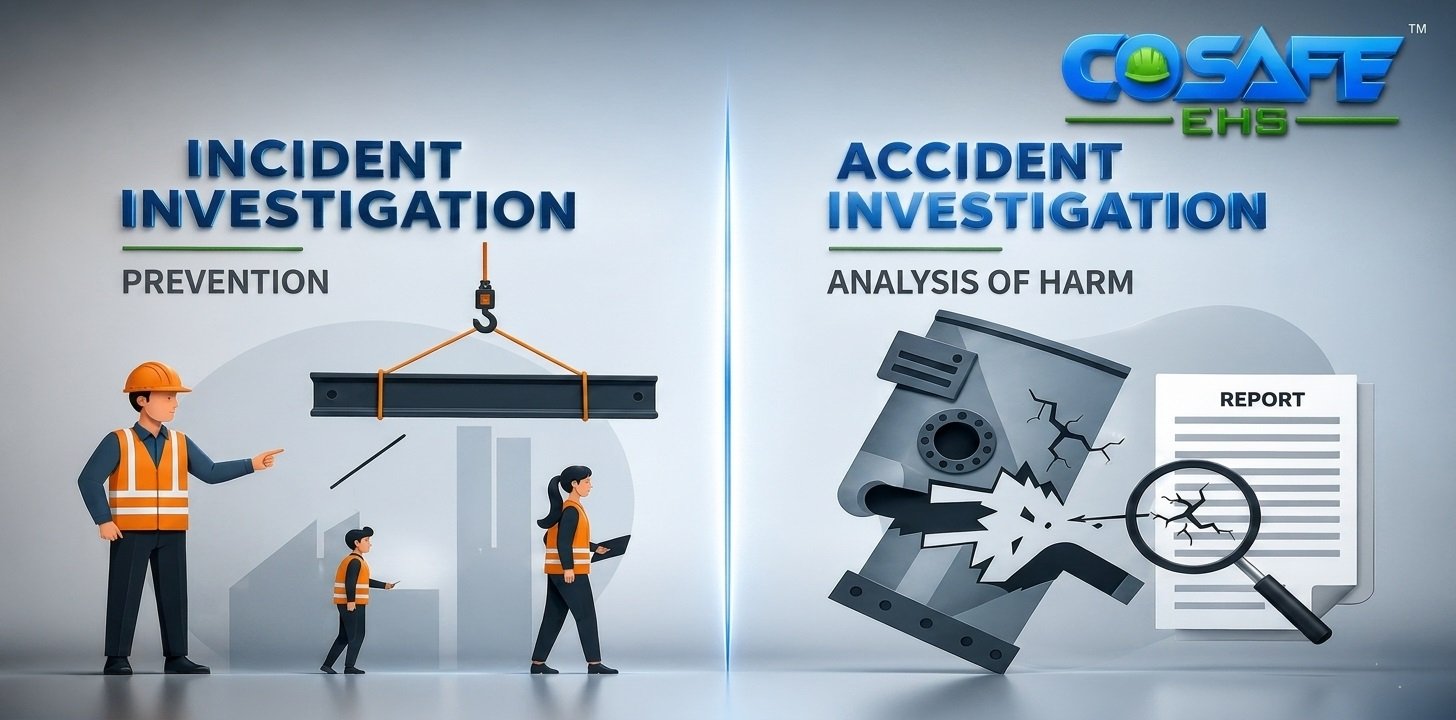
Every workplace incident, near miss, unsafe act, property damage event, occupational illness, environmental release, or serious injury provides valuable lessons that can help prevent future occurrences. However, organizations often focus on identifying who was involved rather than understanding why the incident occurred. Effective Accident Investigation & Analysis goes beyond assigning blame—it identifies root causes, system failures, human factors, organizational weaknesses, and process gaps that contribute to incidents.
Across industries such as manufacturing, construction, oil & gas, logistics, warehousing, healthcare, power generation, pharmaceuticals, infrastructure projects, and facility management, workplace accidents can result in injuries, fatalities, equipment damage, production losses, legal liabilities, reputational harm, and increased operational costs. Conducting a systematic and professional accident investigation is essential for preventing recurrence and strengthening workplace safety performance.
At Cosafe EHS Bangalore, our Accident Investigation & Analysis Training Program equips Safety Officers, EHS Professionals, Supervisors, Managers, Incident Investigators, Team Leaders, and Emergency Response Personnel with the skills required to conduct effective investigations, identify root causes, gather evidence, analyze incidents, and implement corrective and preventive actions.
The program focuses on internationally accepted accident investigation methodologies, root cause analysis techniques, human factors evaluation, incident reporting systems, and practical case-study-based learning to help organizations build a proactive safety culture.
Why Accident Investigation & Analysis Training is Important
Many organizations repeat the same incidents because investigations focus only on immediate causes rather than underlying system failures. A well-executed investigation helps organizations:
Accident investigation is not about assigning blame—it is about identifying failures and implementing improvements that prevent future incidents.
Accident Investigation is a structured process used to determine:
A thorough investigation examines people, equipment, procedures, environment, management systems, and organizational controls to identify both direct and root causes.
Organizations should investigate:
The key objectives include:
This training is highly beneficial for:
Organizations implementing effective investigation systems achieve:
This training program is suitable for:
At Cosafe EHS Bangalore, our Accident Investigation & Analysis Training is tailored to industry-specific risks, organizational requirements, and workplace operational challenges.
Every workplace accident, near miss, or safety incident represents an opportunity to learn and improve. Organizations that conduct thorough and systematic accident investigations are better equipped to identify root causes, eliminate hazards, strengthen safety systems, and prevent future incidents. Effective investigation is not about finding fault—it is about finding facts and implementing solutions.
At Cosafe EHS Bangalore, our Accident Investigation & Analysis Training Program equips safety professionals, supervisors, managers, engineers, and incident investigators with the practical knowledge, analytical tools, and investigative skills required to conduct professional workplace investigations. Through hands-on exercises, real-world case studies, root cause analysis techniques, and practical workshops, we help organizations build a proactive safety culture focused on prevention and continuous improvement.
Investigate the Cause. Identify the Root Cause. Prevent Recurrence. Choose Cosafe EHS Bangalore for Professional Accident Investigation & Analysis Training in Bangalore.
Participants receive a comprehensive understanding of accident investigation principles.
Topics include:
Participants gain a strong foundation in incident investigation practices.
Understanding why accidents occur is essential for effective investigations.
Training includes:
Participants learn how accidents develop through multiple contributing factors.
Different incidents require different investigation approaches.
Topics include:
Participants learn how to classify and prioritize investigations.
Timely reporting is essential for preserving evidence.
Training includes:
Participants understand the importance of prompt reporting.
Accurate evidence collection forms the foundation of an investigation.
Topics include:
Participants learn systematic evidence-gathering methods.
Effective interviews help investigators understand incident circumstances.
Training includes:
Participants develop professional interviewing skills.
Root Cause Analysis is a critical component of accident investigation.
Topics include:
Participants learn how to move beyond surface-level causes.
Various analytical tools support effective investigations.
Training includes:
Participants gain practical experience using investigation tools.
Human behavior often contributes to workplace incidents.
Topics include:
Participants understand the role of human factors in incident causation.
Effective corrective actions prevent recurrence.
Training includes:
Participants learn how to develop meaningful corrective actions.
Analyzing incident data supports proactive safety management.
Topics include:
Participants learn how to use data to improve safety performance.
Clear reporting ensures lessons are communicated effectively.
Training includes:
Participants improve professional report-writing skills.
Investigations often support regulatory and compliance requirements.
Topics include:
Participants understand the legal aspects of investigations.
Real-world examples strengthen learning outcomes.
Exercises include:
Participants apply investigation techniques to realistic scenarios.
Participants conduct simulated investigations.
Activities include:
This practical exercise develops real-world investigation competency.
At Cosafe EHS Bangalore, our Accident Investigation & Analysis Training follows a practical, interactive, and competency-based learning approach designed to develop confident and capable workplace investigators.
Interactive Classroom Learning
Participants receive structured instruction through:
This creates a strong theoretical foundation.
Real Incident Case Study Analysis
Participants examine actual workplace incidents involving:
Case studies provide practical learning opportunities.
Group Investigation Workshops
Participants work in teams to:
This strengthens analytical and teamwork skills.
Practical Evidence Collection Exercises
Hands-on activities include:
Participants gain practical investigation experience.
Root Cause Analysis Simulations
Participants perform:
These activities build problem-solving capabilities.
Interviewing Skill Development
Participants engage in:
These exercises improve information-gathering effectiveness.
Incident Reporting and Documentation Practice
Participants learn through:
This strengthens professional reporting skills.
Competency Assessment and Evaluation
Participants are evaluated through:
Certificates are awarded upon successful completion of the training program.