Bangalore Office
Warehouse No 4, Survey No 198/6, Janatha Colony, Dommsandra Bangalore Karnataka 562125

Warehouse No 4, Survey No 198/6, Janatha Colony, Dommsandra Bangalore Karnataka 562125
Godown No 3/C, Survey No. 217, Beside ORR, Shamshabad, R.R. District, Hyderabad, Telangana - 501218
+91 7892978960
corporate@cosafe.in
In today's dynamic industrial and business environment, organizations face numerous risks that can impact employee safety, operational efficiency, regulatory compliance, project success, business continuity, and organizational reputation. Whether in manufacturing, construction, oil & gas, pharmaceuticals, logistics, power generation, healthcare, or infrastructure projects, the ability to identify, assess, and prioritize risks before they become incidents is essential for sustainable business operations.
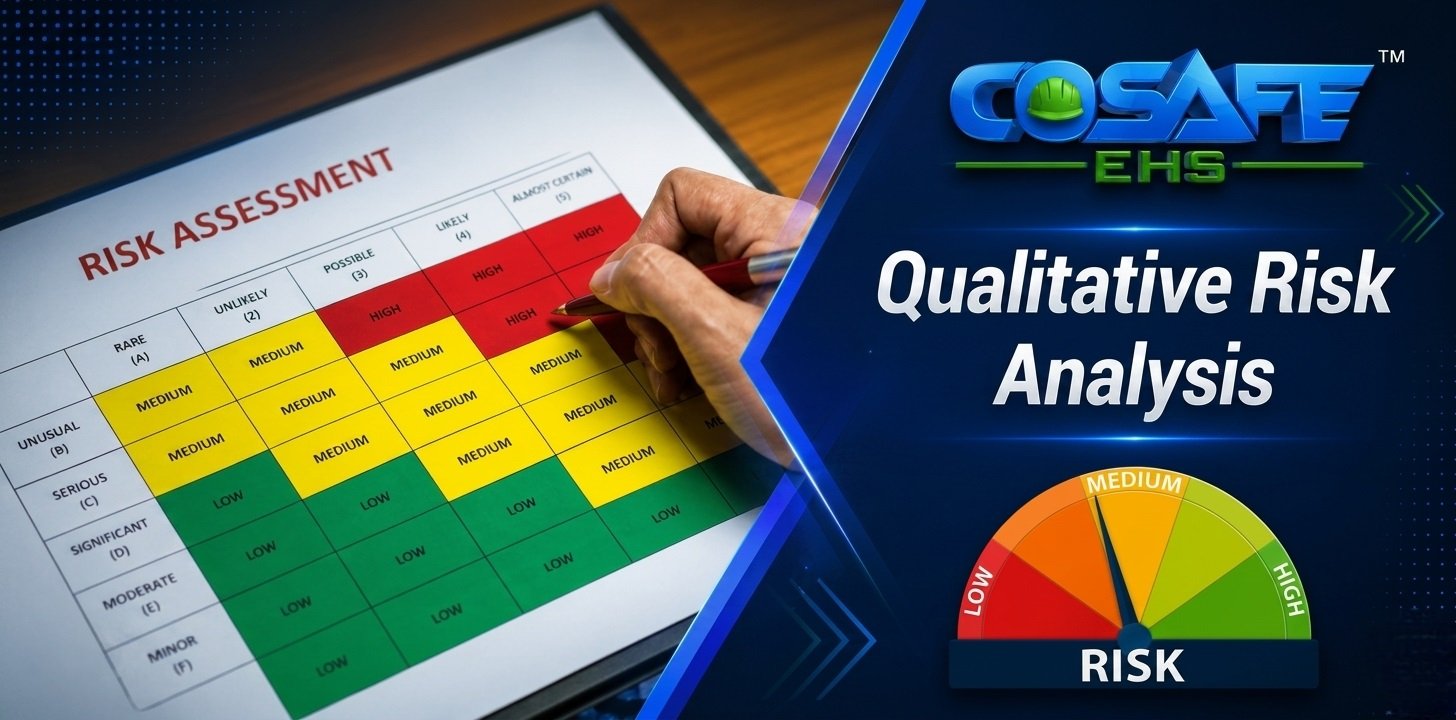
Qualitative Risk Analysis (QRA) is one of the most widely used risk assessment methodologies that enables organizations to evaluate risks using descriptive criteria such as likelihood, severity, and impact rather than complex numerical calculations. It provides a practical and effective approach for identifying hazards, prioritizing risks, and implementing control measures when detailed statistical data is unavailable. Qualitative risk analysis is commonly used as the first stage of risk management and forms the foundation of many workplace safety and operational risk assessment programs.
At Cosafe EHS Bangalore, our Qualitative Risk Analysis Training Program is designed to equip safety professionals, engineers, supervisors, managers, project teams, and operational personnel with the knowledge and practical skills required to identify hazards, evaluate risks, develop risk matrices, prioritize corrective actions, and improve organizational risk management systems.
Qualitative Risk Analysis is a structured process used to evaluate risks based on descriptive categories such as:
and consequence levels such as:
These ratings are combined through a risk matrix to determine the overall risk level and prioritize actions. Qualitative assessments are particularly useful when numerical data is limited or when organizations need a practical and efficient method to screen and manage workplace risks.
Many organizations struggle with identifying which risks require immediate attention and which can be monitored over time. Qualitative Risk Analysis helps organizations make informed decisions by prioritizing risks based on their likelihood and potential impact.
Key benefits include:
Qualitative assessment is often the preferred approach for routine workplace risk assessments because it is simple, fast, and understandable to managers, supervisors, and workers alike.
The primary objectives of the training include:
Participants learn to evaluate various categories of risks including:
This training is highly beneficial for:
Organizations implementing qualitative risk assessment programs can achieve:
This program is ideal for:
At Cosafe EHS Bangalore, our training programs are tailored to industry-specific risks and organizational requirements, ensuring maximum practical value for participants.
Effective risk management begins with understanding and prioritizing risks before they result in incidents, losses, or operational disruptions. Qualitative Risk Analysis provides organizations with a practical, structured, and highly effective method for identifying hazards, evaluating risks, and implementing preventive controls even when detailed numerical data is unavailable. It remains one of the most important tools used in workplace safety, operational excellence, and organizational risk management.
At Cosafe EHS Bangalore, our Qualitative Risk Analysis Training Program equips safety professionals, engineers, supervisors, managers, and operational teams with the knowledge, skills, and confidence required to perform effective risk assessments and make informed safety decisions. Through practical workshops, real-world case studies, risk matrix exercises, and industry-focused learning, we help organizations strengthen risk management capabilities and build safer, more resilient workplaces.
Identify the Risk. Evaluate the Impact. Prioritize the Action. Choose Cosafe EHS Bangalore for Professional Qualitative Risk Analysis Training in Bangalore.
Participants receive a comprehensive overview of risk management principles.
Topics include:
This module establishes the foundation for effective risk management.
Participants learn the principles and applications of qualitative risk analysis.
Training includes:
Participants understand when and how qualitative risk analysis should be applied.
Effective risk analysis begins with hazard identification.
Topics include:
Participants develop systematic hazard recognition skills.
This module focuses on identifying and classifying risks.
Training includes:
Participants learn how to classify risks for better management.
Module 5: Likelihood Assessment
Participants learn how to evaluate the probability of risk occurrence.
Topics include:
Participants learn consistent methods for likelihood rating.
Understanding impact is critical for risk prioritization.
Training includes:
Injury severity
Property damage
Environmental impact
Business interruption
Financial consequences
Reputational impact
Participants learn to assess potential outcomes objectively.
Risk matrices are among the most widely used qualitative risk analysis tools.
Topics include:
Probability scales
Consequence scales
Risk ranking systems
Color-coded matrices
Risk prioritization
Decision-making frameworks
Participants gain hands-on experience in building and using risk matrices.
Participants learn how to prioritize risks based on assessment outcomes.
Training includes:
This module improves organizational decision-making capabilities.
Identifying risks is only the beginning; controlling them is the objective.
Topics include:
Participants learn practical risk reduction strategies.
Proper documentation supports accountability and continuous improvement.
Training includes:
Participants learn effective documentation practices.
Qualitative risk analysis often relies on team expertise.
Topics include:
Participants learn how collaborative risk assessments improve accuracy.
Risk analysis supports multiple organizational systems.
Training includes:
Participants understand how risk analysis strengthens safety management systems.
Human behavior influences risk assessment outcomes.
Topics include:
Participants learn how human factors affect risk management.
Participants analyze real-world examples from:
Case studies improve practical understanding and application.
Participants conduct complete qualitative risk assessments.
Activities include:
These exercises build practical workplace competency.
At Cosafe EHS Bangalore, our Qualitative Risk Analysis Training Program follows a practical, competency-based, and industry-focused learning approach designed to build confident risk assessment professionals.
Interactive Classroom Sessions
Participants receive structured instruction through:
This establishes a strong theoretical foundation.
Practical Risk Assessment Exercises
Participants perform:
Hands-on learning improves practical competency.
Risk Matrix Workshops
Participants learn through:
These workshops build confidence in qualitative risk assessment techniques.
Industry-Specific Case Studies
Participants analyze:
Case studies connect theory with real-world applications.
Group Discussions and Team Learning
Collaborative activities include:
These sessions improve teamwork and analytical thinking.
Scenario-Based Learning
Participants evaluate realistic scenarios involving:
This approach develops decision-making skills.
Documentation and Reporting Practice
Participants learn through:
These exercises improve professional documentation capabilities.
Competency Assessment and Certification
Participants are evaluated through:
Certificates are awarded upon successful completion of the training program.