Bangalore Office
Warehouse No 4, Survey No 198/6, Janatha Colony, Dommsandra Bangalore Karnataka 562125

Warehouse No 4, Survey No 198/6, Janatha Colony, Dommsandra Bangalore Karnataka 562125
Godown No 3/C, Survey No. 217, Beside ORR, Shamshabad, R.R. District, Hyderabad, Telangana - 501218
+91 7892978960
corporate@cosafe.in
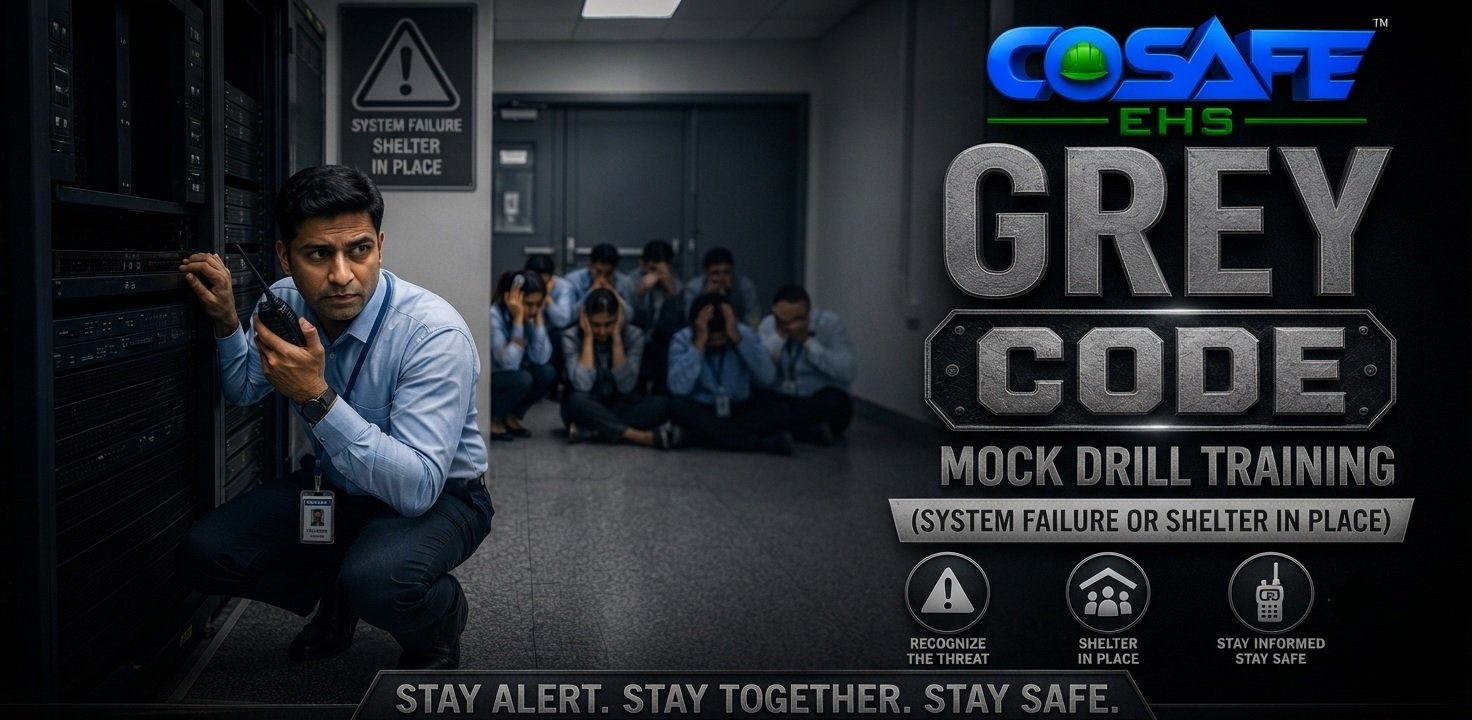
Modern organizations rely heavily on critical infrastructure, utilities, information technology systems, communication networks, power supplies, heating, ventilation and air conditioning (HVAC), medical gases, water systems, and physical security controls to maintain safe and uninterrupted operations. Any unexpected failure of these essential systems or the need to initiate a Shelter-in-Place due to external hazards can rapidly escalate into a major emergency affecting employee safety, patient care, business continuity, and regulatory compliance.
At Cosafe EHS Bangalore, our Grey Code Mock Drill Training (System Failure or Shelter-in-Place Emergency) is designed to prepare organizations for infrastructure failures, utility disruptions, cyber-related operational outages, external air contamination events, hazardous environmental conditions, and shelter-in-place emergencies through realistic mock drills, structured emergency planning, Incident Command System (ICS), emergency communication, business continuity planning, and coordinated response exercises.
This competency-based program equips Emergency Response Teams (ERT), facility managers, engineers, healthcare professionals, security personnel, IT teams, and organizational leaders with the knowledge and practical skills required to respond effectively while minimizing operational disruption and protecting lives.
The training follows internationally recognized emergency management principles, business continuity practices, occupational safety standards, healthcare emergency preparedness guidelines, and crisis management frameworks to improve organizational resilience.
A Grey Code (Code Grey) is an emergency notification used by many healthcare facilities and organizations to indicate a System Failure, Infrastructure Loss, or Shelter-in-Place Emergency requiring immediate activation of emergency response procedures.
Depending on the organization's emergency response policy, Grey Code may be activated for:
The primary objective of Grey Code is to protect occupants, maintain essential operations, activate contingency plans, coordinate emergency resources, and restore critical systems safely and efficiently.
Emergency colour-code systems vary significantly between countries and organizations. Grey Code is commonly used for System Failure, Infrastructure Loss, or Shelter-in-Place emergencies in healthcare facilities and public institutions across:
Important Note: Emergency colour codes are not internationally standardized. In many Canadian healthcare systems, Code Grey commonly refers to system or infrastructure failure or external air exclusion/shelter-in-place, while other organizations may assign different meanings such as a combative person or severe weather. Every organization should follow its approved Emergency Response Plan (ERP), Business Continuity Plan (BCP), Disaster Management Plan (DMP), and applicable local regulations.
Critical infrastructure failures or external environmental threats can severely impact business operations and public safety. Without proper preparedness, organizations may experience prolonged operational downtime, communication failures, disruption of essential services, safety risks, and financial losses.
Regular Grey Code Mock Drill Training enables organizations to:
The program aims to:
Organizations conducting regular Grey Code drills benefit through:
This training is suitable for:
This training is recommended for:
Overview of Grey Code emergencies, infrastructure resilience, business continuity, emergency preparedness, organizational responsibilities, and regulatory requirements.
Understanding electrical systems, water supply, HVAC, medical gas systems, communication networks, fire protection systems, IT infrastructure, and essential facility services.
Emergency notification systems, activation criteria, communication hierarchy, escalation procedures, documentation, emergency reporting, and operational control.
Power outage response, generator activation, utility failure management, IT contingency procedures, manual operational controls, and service restoration planning.
Decision-making criteria, building isolation, access control, HVAC shutdown where appropriate, occupant protection, accountability systems, communication, and safe occupancy management.
Emergency leadership, command structure, resource allocation, operational coordination, emergency documentation, decision-making, and recovery management.
Internal communication systems, emergency announcements, stakeholder communication, external agency coordination, media awareness, and crisis communication management.
Business Impact Analysis (BIA), contingency planning, critical function prioritization, resource management, continuity strategies, and operational recovery.
Damage assessment, system testing, service restoration, corrective actions, preventive maintenance, lessons learned, and continuous improvement planning.
Participants conduct realistic simulations involving Grey Code activation, infrastructure failure response, shelter-in-place implementation, Incident Command activation, emergency communication, contingency operations, recovery coordination, documentation, and post-drill evaluation.