Bangalore Office
Warehouse No 4, Survey No 198/6, Janatha Colony, Dommsandra Bangalore Karnataka 562125

Warehouse No 4, Survey No 198/6, Janatha Colony, Dommsandra Bangalore Karnataka 562125
Godown No 3/C, Survey No. 217, Beside ORR, Shamshabad, R.R. District, Hyderabad, Telangana - 501218
+91 7892978960
corporate@cosafe.in
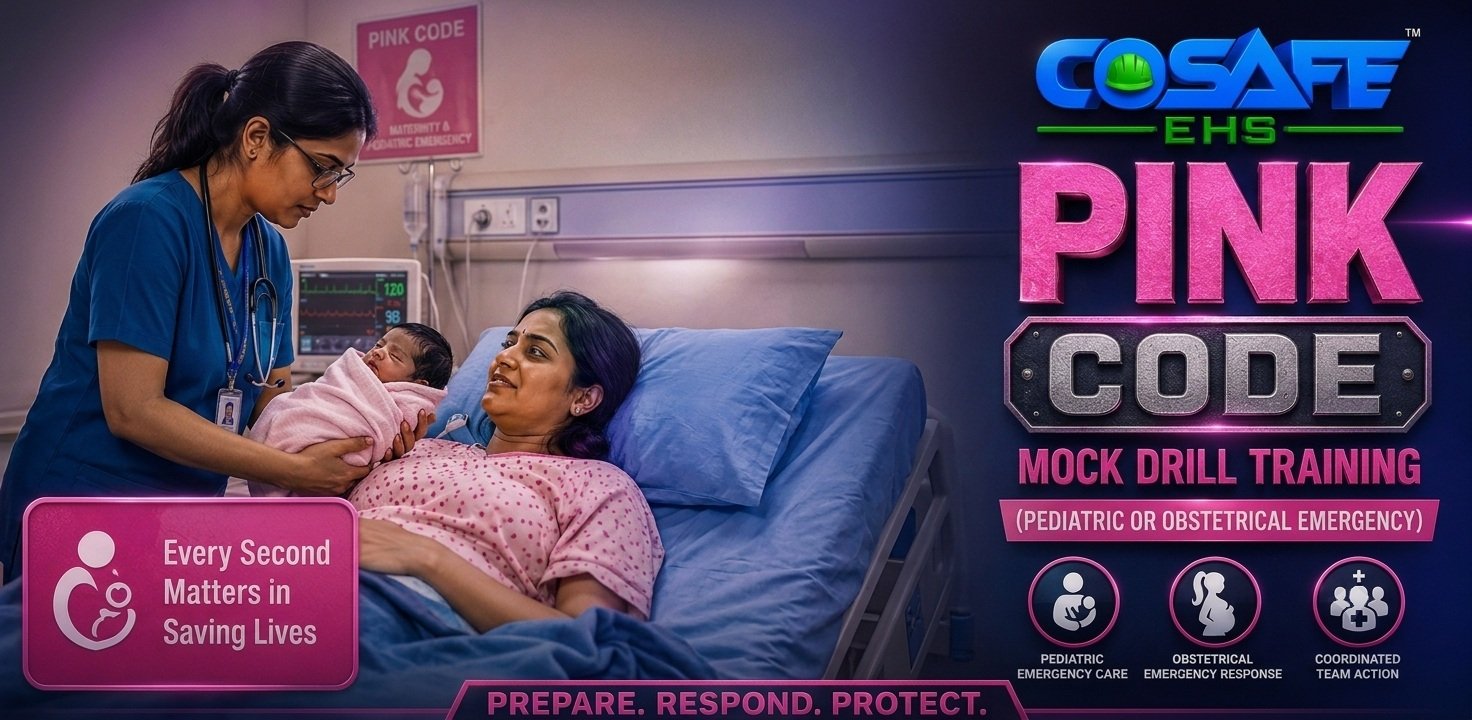
Pediatric and obstetrical emergencies are among the most critical medical situations encountered in healthcare facilities. These emergencies require rapid assessment, immediate clinical intervention, seamless communication, multidisciplinary coordination, and well-rehearsed emergency response procedures to protect the lives of newborns, children, pregnant women, and mothers. Delays in response, inadequate coordination, or lack of preparedness can significantly impact patient outcomes and organizational reputation.
At Cosafe EHS Bangalore, our Pink Code Mock Drill Training (Pediatric or Obstetrical Emergency) is designed to help hospitals, maternity hospitals, pediatric centers, medical colleges, emergency departments, and healthcare organizations strengthen their emergency preparedness through realistic simulations, structured emergency response protocols, multidisciplinary teamwork, and competency-based practical exercises.
The program focuses on enhancing emergency readiness for pediatric medical emergencies, neonatal emergencies, obstetrical complications, maternal emergencies, neonatal resuscitation preparedness, emergency communication, Incident Command System (ICS), patient transfer coordination, and post-incident evaluation. Through realistic mock drills and simulation-based learning, healthcare professionals gain confidence in managing high-risk situations while improving patient safety and clinical outcomes.
A Pink Code is an emergency notification used by many healthcare organizations to indicate a Pediatric or Obstetrical Emergency, requiring immediate activation of specialized emergency response teams to provide urgent care for infants, children, newborns, pregnant women, or obstetrical patients.
Depending on the healthcare organization, Pink Code may be activated for:
The primary objective of a Pink Code is to ensure rapid mobilization of specialized medical teams, immediate life-saving intervention, coordinated communication, and timely patient stabilization.
Emergency colour-code systems vary between countries and healthcare organizations. Pink Code for pediatric or obstetrical emergencies is commonly
implemented in various healthcare facilities across:
Important Note: Emergency colour codes are not internationally standardized. In several countries, particularly many hospitals in the United States, Code Pink commonly refers to infant or child abduction, whereas other healthcare organizations use Pink Code for pediatric or obstetrical emergencies. Every healthcare facility should therefore train according to its approved Emergency Response Plan (ERP), Hospital Emergency Code Policy, and national healthcare regulations.
Medical emergencies involving newborns, infants, children, and pregnant women require immediate action. Regular Pink Code Mock Drills help organizations:
The program aims to:
This training is suitable for:
Pediatric and obstetrical emergencies demand immediate recognition, rapid intervention, skilled teamwork, and effective communication. Regular Pink Code Mock Drill Training enables healthcare organizations to strengthen emergency preparedness, improve response times, validate emergency protocols, and enhance patient safety.
At Cosafe EHS Bangalore, our Pink Code Mock Drill Training (Pediatric or Obstetrical Emergency) equips healthcare professionals with the knowledge, practical skills, and confidence required to manage critical pediatric and maternal emergencies effectively. Through realistic simulations, structured evaluations, and internationally aligned emergency preparedness practices, we help healthcare organizations build safer hospitals, stronger emergency response systems, and improved clinical outcomes for mothers, newborns, and children.
Overview of pediatric and obstetrical emergencies, emergency preparedness principles, legal responsibilities, patient safety standards, and hospital emergency management systems.
Identification of pediatric emergencies including respiratory distress, cardiac arrest, seizures, trauma, poisoning, allergic reactions, and shock.
Recognition and response to maternal hemorrhage, eclampsia, obstetric trauma, emergency delivery, fetal distress, maternal collapse, and high-risk pregnancy complications.
Emergency response for newborn resuscitation, neonatal stabilization, airway management awareness, thermoregulation, and emergency neonatal transfer.
Emergency notification systems, activation criteria, communication hierarchy, escalation procedures, documentation, and emergency response timelines.
Hospital Incident Command System (HICS), emergency leadership, resource management, role allocation, decision-making, and documentation during pediatric emergencies.
Internal communication, emergency announcements, family communication protocols, interdepartmental coordination, ambulance coordination, and emergency reporting.
Safe movement of pediatric and obstetrical patients, transfer protocols, ambulance coordination, referral procedures, and continuity of care.
Emergency crash carts, neonatal equipment, pediatric emergency devices, obstetric emergency kits, oxygen systems, monitoring equipment, and equipment readiness.
Coordination between emergency physicians, pediatricians, obstetricians, anesthetists, nursing teams, laboratory services, blood bank, pharmacy, radiology, and administration.
Communication with patient families, emotional support, crisis counseling awareness, family guidance, and compassionate emergency management.
Hand hygiene, PPE, infection prevention, biomedical waste management, patient isolation procedures, and emergency infection control.
Realistic simulation involving emergency activation, pediatric or obstetrical emergency response, emergency communication, patient stabilization, multidisciplinary coordination, and emergency documentation.
Assessment of response times, communication effectiveness, patient management, documentation quality, leadership performance, and identification of improvement opportunities.
Development of corrective action plans, protocol revisions, competency enhancement, periodic mock drills, audits, and continuous quality improvement initiatives.
At Cosafe EHS Bangalore, our Pink Code Mock Drill Training follows a competency-based, practical, and simulation-driven methodology aligned with international healthcare emergency preparedness practices.
Training begins with interactive classroom sessions covering pediatric emergencies, obstetrical emergencies, neonatal care awareness, emergency communication, Hospital Incident Command System (HICS), patient safety, and emergency preparedness principles. Expert faculty explain emergency protocols using case studies, real-life examples, multimedia presentations, and interactive discussions.
Participants then engage in tabletop exercises and scenario-based simulations involving neonatal emergencies, maternal emergencies, pediatric trauma, emergency deliveries, patient deterioration, emergency communication, and multidisciplinary coordination. These exercises improve decision-making, teamwork, and clinical communication in high-pressure situations.
Practical demonstrations include emergency equipment familiarization, crash cart readiness, neonatal emergency equipment awareness, patient transport procedures, emergency documentation, communication systems, and role-based emergency response activities.
The training culminates in a full-scale Pink Code Mock Drill, where participants respond to realistic emergency scenarios involving pediatric or obstetrical emergencies. The exercise evaluates activation procedures, communication efficiency, team coordination, patient stabilization processes, Incident Command implementation, and overall emergency preparedness.
Each mock drill concludes with a structured debriefing session where instructors evaluate response time, teamwork, protocol compliance, leadership effectiveness, documentation accuracy, communication performance, and opportunities for improvement. Corrective actions and recommendations are provided to strengthen organizational preparedness and patient safety.
Participants are assessed through written evaluations, practical exercises, emergency simulations, teamwork performance, and active participation during the mock drill. Upon successful completion, certificates are awarded recognizing competency in Pink Code emergency preparedness.