Bangalore Office
Warehouse No 4, Survey No 198/6, Janatha Colony, Dommsandra Bangalore Karnataka 562125

Warehouse No 4, Survey No 198/6, Janatha Colony, Dommsandra Bangalore Karnataka 562125
Godown No 3/C, Survey No. 217, Beside ORR, Shamshabad, R.R. District, Hyderabad, Telangana - 501218
+91 7892978960
corporate@cosafe.in
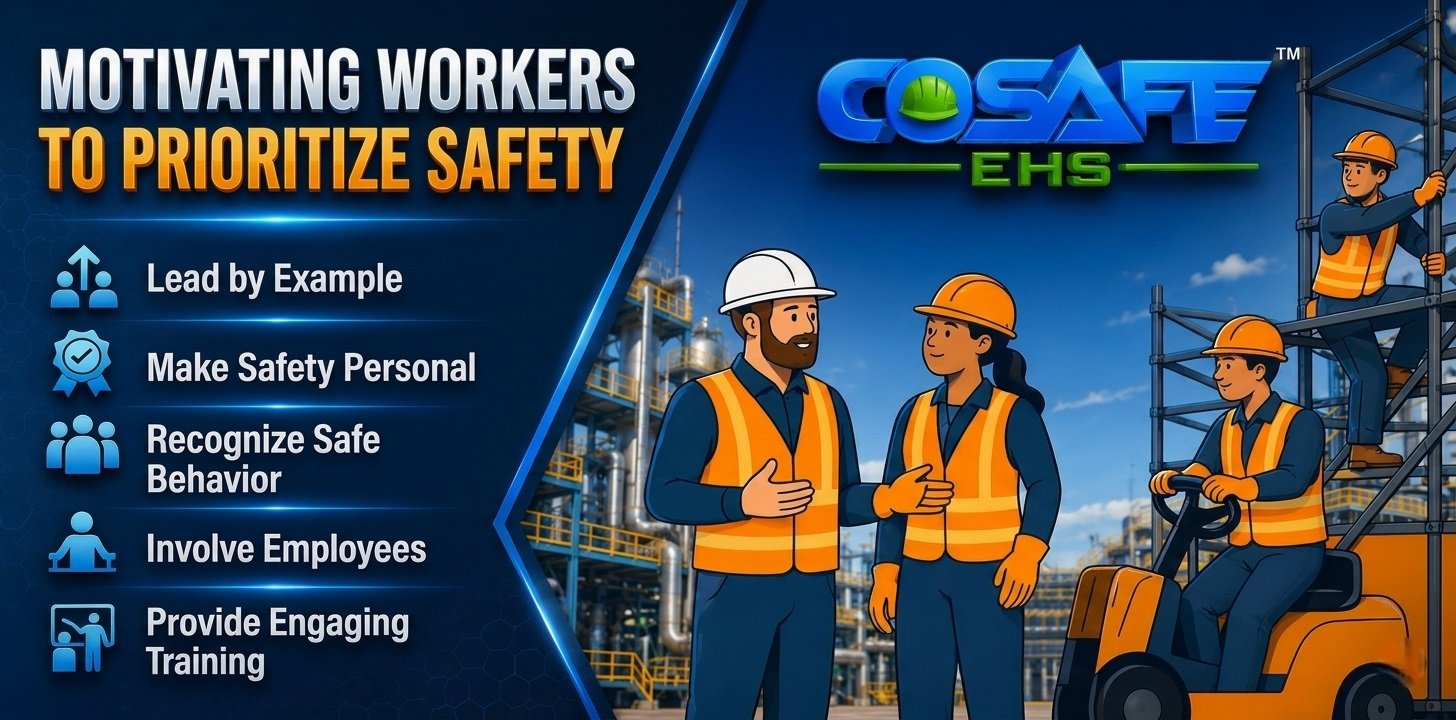
A safe workplace is not created by safety rules alone. While policies, procedures, PPE, and safety systems are essential, the true success of any Occupational Health and Safety Management System depends on people. Employees who are motivated, engaged, and committed to safety are far more likely to identify hazards, follow procedures, report unsafe conditions, and contribute to accident prevention.
Many workplace incidents occur not because employees lack knowledge, but because of poor safety attitudes, complacency, lack of motivation, weak supervision, ineffective communication, and inadequate leadership involvement. Building a strong safety culture requires organizations to effectively organize safety activities and motivate employees to actively participate in workplace safety initiatives.
At Cosafe EHS Bangalore, our Organizing and Motivating for Safety Training Program is designed to help organizations develop a positive safety culture where safety becomes a shared responsibility rather than a compliance requirement. The program focuses on safety leadership, employee engagement, behavioral safety, communication techniques, motivation strategies, and workforce participation to improve overall safety performance and organizational effectiveness.
Organizing and Motivating for Safety refers to the systematic process of creating structures, responsibilities, communication channels, leadership practices, and motivational techniques that encourage employees to work safely and participate actively in safety improvement programs.
The objective is to create an environment where:
Organizations with strong safety cultures consistently experience fewer accidents, higher productivity, improved employee morale, and better operational performance. Effective safety motivation helps bridge the gap between knowing safety procedures and actually following them. Research and industry experience consistently show that leadership engagement, communication, and behavioral reinforcement play a major role in developing sustainable safety cultures.
The training aims to:
When employees are motivated, safety performance improves naturally rather than through enforcement alone.
Organizations implementing effective safety motivation strategies benefit from:
This training is valuable for:
This program is ideal for:
At Cosafe EHS Bangalore, our training is customized according to organizational culture, workforce demographics, industry requirements, and business objectives.
Creating a safe workplace requires more than rules, procedures, and compliance programs. Sustainable safety performance is achieved when employees are organized, motivated, engaged, and committed to working safely every day. Strong leadership, effective communication, positive reinforcement, and active workforce participation are the foundations of a successful safety culture.
At Cosafe EHS Bangalore, our Organizing and Motivating for Safety Training Program equips leaders, supervisors, safety professionals, and employees with the knowledge, skills, and motivation needed to build a proactive safety culture. Through practical exercises, leadership development, behavioral safety principles, and employee engagement strategies, we help organizations transform safety from a compliance requirement into a shared organizational value.
Organize for Safety. Motivate for Excellence. Build a Culture Where Everyone Goes Home Safe. Choose Cosafe EHS Bangalore for Professional Organizing and Motivating for Safety Training in Bangalore.
Participants gain an understanding of how organizational culture influences workplace safety.
Topics include:
Participants learn how culture influences workplace behavior and decision-making.
This module focuses on establishing effective safety structures.
Training includes:
Participants learn how to organize workplace safety effectively.
Strong leadership is the foundation of safety success.
Topics include:
Participants understand how leaders influence workplace safety performance.
This module explores motivational principles applied to workplace safety.
Training includes:
Participants learn how to motivate employees to adopt safe work practices.
Behavior plays a critical role in accident prevention.
Topics include:
Participants understand how behavior influences workplace safety.
Effective communication is essential for safety performance.
Training includes:
Participants improve their ability to communicate safety expectations clearly.
An engaged workforce contributes significantly to safety improvement.
Topics include:
Participants learn how to encourage active participation in safety initiatives.
Attitudes influence workplace behaviors and decision-making.
Training includes:
Participants learn techniques for creating positive safety attitudes.
Recognition reinforces positive behavior.
Topics include:
Participants learn how to encourage long-term safety engagement.
Resistance can hinder safety improvement efforts.
Training includes:
Participants develop strategies for overcoming barriers to safety.
Leaders must coach employees toward safer behaviors.
Topics include:
Participants strengthen leadership and coaching competencies.
Teamwork enhances safety performance.
Training includes:
Participants learn how to build high-performing safety teams.
Organizations improve by learning from experience.
Topics include:
Participants learn how organizational learning supports safety excellence.
Safety campaigns help sustain engagement.
Training includes:
Participants learn how to maintain safety enthusiasm across the workforce.
The final module focuses on long-term success.
Topics include:
Participants learn how to sustain safety motivation and engagement over time.
At Cosafe EHS Bangalore, our Organizing and Motivating for Safety Training follows a highly interactive, practical, and behavior-focused methodology designed to create lasting improvements in workplace safety culture.
Interactive Classroom Sessions
Participants receive structured learning through:
This establishes a strong theoretical foundation.
Real-Life Incident Case Studies
Participants analyze actual workplace incidents to understand:
Case studies improve practical understanding and retention.
Group Discussions and Team Activities
Collaborative learning includes:
These activities strengthen engagement and participation.
Role Plays and Safety Leadership Exercises
Participants practice:
Practical exercises improve confidence and workplace application.
Behavioral Observation Workshops
Participants learn through:
These workshops strengthen behavioral safety competencies.
Scenario-Based Learning
Participants evaluate realistic workplace situations involving:
Scenario-based learning improves decision-making skills.
Safety Communication Practice Sessions
Participants develop skills through:
These activities enhance workplace communication effectiveness.
Competency Assessment and Certification
Participants are evaluated through:
Certificates are awarded upon successful completion of the training program.