Bangalore Office
Warehouse No 4, Survey No 198/6, Janatha Colony, Dommsandra Bangalore Karnataka 562125

Warehouse No 4, Survey No 198/6, Janatha Colony, Dommsandra Bangalore Karnataka 562125
Godown No 3/C, Survey No. 217, Beside ORR, Shamshabad, R.R. District, Hyderabad, Telangana - 501218
+91 7892978960
corporate@cosafe.in
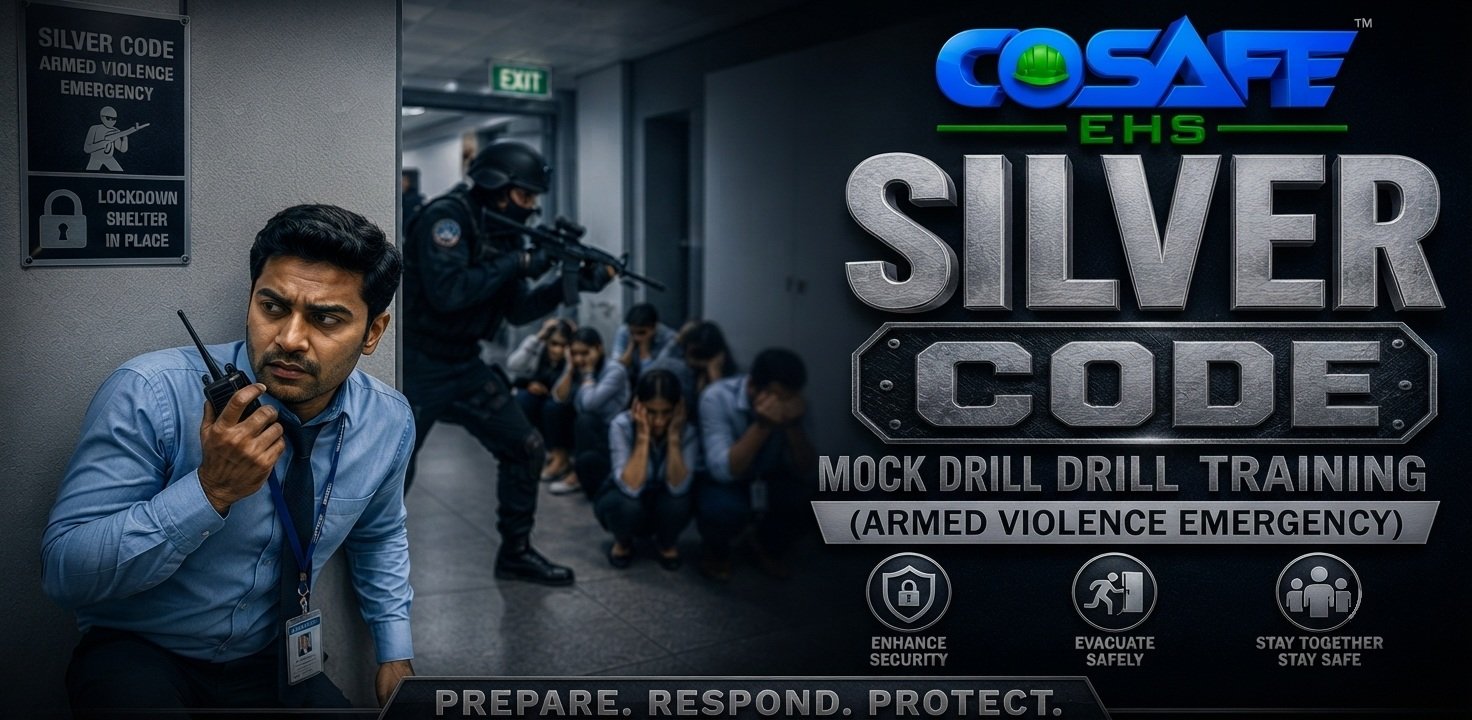
Armed violence incidents are among the most critical and rapidly evolving emergencies that organizations may face. These situations may involve an active shooter, armed intruder, armed robbery, terrorist attack, weapon-related assault, or any individual threatening people with firearms or other lethal weapons. Such incidents require immediate activation of emergency response procedures, rapid communication, coordinated decision-making, effective lockdown measures, and close coordination with law enforcement agencies to protect lives and minimize casualties.
At Cosafe EHS Bangalore, our Silver Code Mock Drill Training (Armed Violence Emergency) is designed to strengthen organizational preparedness through realistic simulations, structured emergency planning, crisis leadership, Incident Command System (ICS), lockdown and evacuation strategies, emergency communication, and post-incident recovery planning. The program enables organizations to develop a proactive security culture while preparing employees, emergency response teams, and management to respond effectively during armed violence emergencies.
Using practical scenario-based learning and full-scale mock drills, participants gain the confidence and competence to recognize threats, activate emergency procedures, coordinate with police and emergency responders, protect occupants, and support business continuity while maintaining calm under pressure.
The training aligns with internationally recognized emergency management principles, workplace violence prevention strategies, business continuity practices, occupational safety requirements, and organizational crisis management frameworks.
A Silver Code (Code Silver) is an emergency notification used by many hospitals, healthcare organizations, airports, government facilities, educational institutions, and corporate organizations to indicate an Armed Violence Emergency, such as an active shooter or armed intruder requiring immediate protective action.
Depending on the organization's emergency response policy, Silver Code may be activated during:
The primary objective of Silver Code is to immediately notify occupants, initiate protective actions, activate emergency communication systems, coordinate with law enforcement agencies, protect lives, isolate affected areas, and safely manage the emergency until it is resolved.
Emergency colour-code systems differ significantly across countries and organizations. Code Silver is widely recognized in many healthcare systems and public institutions for armed violence or active shooter emergencies and is commonly implemented in:
Important Note: Emergency colour codes are not internationally standardized. Many healthcare organizations in Canada, the United States, and Australia use Code Silver to indicate an active shooter or armed person, while some organizations may assign different meanings. Every organization should always follow its approved Emergency Response Plan (ERP), Security Management Plan, Crisis Management Plan, and applicable national regulations.
Armed violence incidents develop within seconds and often create panic, confusion, and significant risk to employees, patients, visitors, and emergency responders. Organizations that regularly conduct Silver Code Mock Drills improve preparedness, communication, leadership, and coordinated emergency response.
Without regular training, organizations may experience:
The program aims to:
Organizations implementing regular Silver Code drills benefit through:
This training is suitable for:
This program is recommended for:
Armed violence emergencies require immediate recognition, rapid communication, decisive leadership, disciplined teamwork, and close coordination with law enforcement agencies. Regular Silver Code Mock Drill Training enables organizations to validate emergency procedures, strengthen security preparedness, improve response efficiency, and protect employees, patients, visitors, and critical assets.
At Cosafe EHS Bangalore, our Silver Code Mock Drill Training (Armed Violence Emergency) equips organizations with internationally aligned security preparedness practices, realistic emergency simulations, and competency-based learning to effectively manage active shooter and armed intruder incidents. Through expert guidance, structured evaluations, and practical mock drills, we help organizations build safer workplaces, stronger emergency response systems, enhanced business continuity, and a resilient culture of security and preparedness.
Overview of armed violence emergencies, workplace violence prevention, emergency preparedness, legal responsibilities, organizational security policies, and crisis management principles.
Identification of suspicious behaviour, threat indicators, armed violence risk factors, vulnerability assessments, workplace security awareness, and preventive measures.
Emergency notification systems, activation criteria, emergency announcements, communication hierarchy, escalation procedures, documentation, and reporting protocols.
Planning and implementation of lockdown procedures, access control, safe rooms, shelter-in-place strategies, controlled evacuation, accountability systems, and occupant protection.
Internal emergency communication, mass notification systems, emergency messaging, family communication, media awareness, information management, and crisis leadership.
Emergency command structure, leadership roles, resource management, decision-making, operational coordination, documentation, and emergency control during armed violence incidents.
Police response procedures, perimeter management, evidence preservation, emergency medical coordination, intelligence sharing, and post-incident investigation support.
Personal safety principles, situational awareness, protective actions, emergency instructions, assisting vulnerable persons, and psychological preparedness during armed violence incidents.
Operational recovery planning, damage assessment, employee assistance, trauma support, psychological first aid awareness, business continuity planning, and restoration of normal operations.
Participants conduct realistic armed violence emergency simulations involving Silver Code activation, emergency communication, lockdown implementation, controlled evacuation, Incident Command activation, coordination with law enforcement, accountability procedures, documentation, and structured post-drill evaluation.