Bangalore Office
Warehouse No 4, Survey No 198/6, Janatha Colony, Dommsandra Bangalore Karnataka 562125
Warehouse No 4, Survey No 198/6, Janatha Colony, Dommsandra Bangalore Karnataka 562125
Godown No 3/C, Survey No. 217, Beside ORR, Shamshabad, R.R. District, Hyderabad, Telangana - 501218
+91 7892978960
corporate@cosafe.in
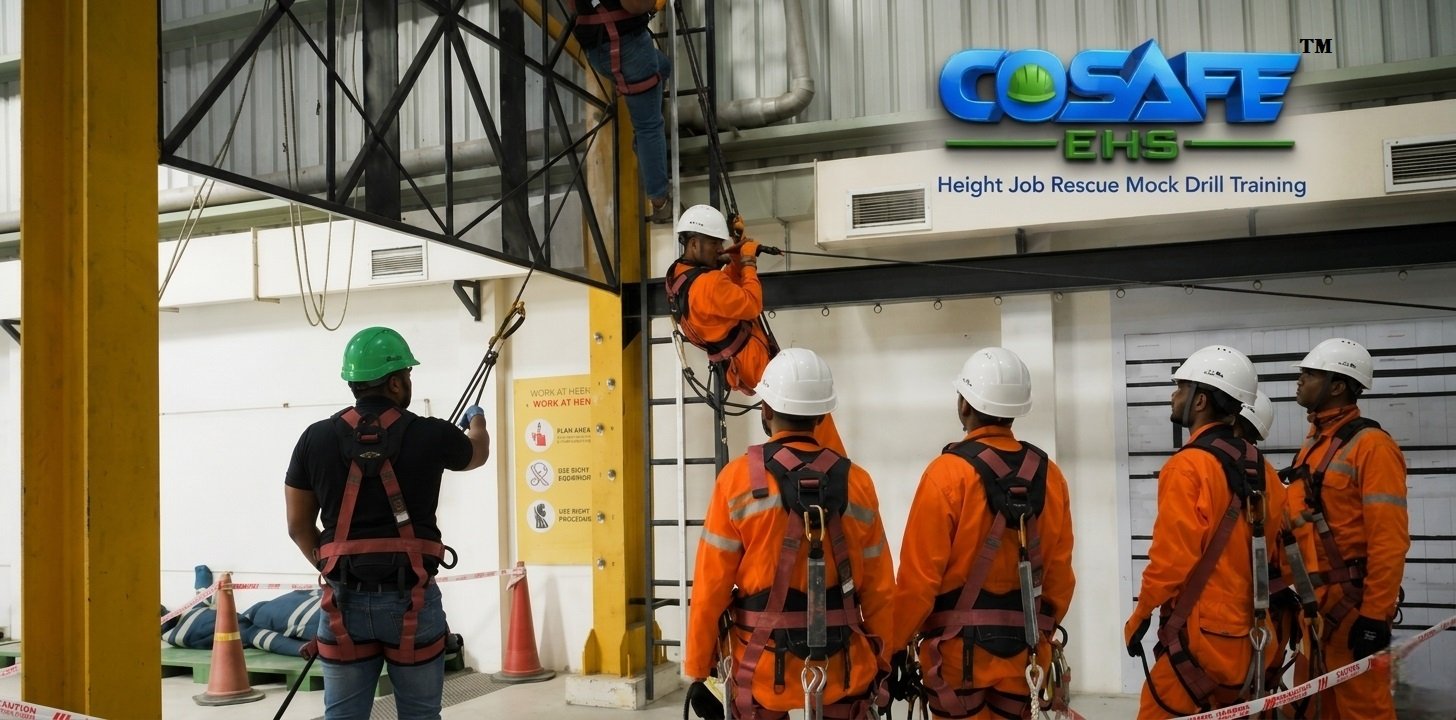
(Work at Height Emergency Rescue Training Program)
Working at height is one of the highest-risk activities across industries such as construction, telecommunications, power transmission, oil & gas, manufacturing, infrastructure development, warehousing, and facility maintenance. Despite implementing fall protection systems and safe work procedures, accidents can still occur due to equipment failure, improper use of personal protective equipment (PPE), adverse weather conditions, human error, structural defects, or medical emergencies.
When a worker falls and remains suspended in a harness, immediate rescue becomes critical. Delayed rescue can lead to Suspension Trauma (Harness Hang Syndrome), restricted blood circulation, unconsciousness, organ damage, and potentially fatal consequences. Therefore, having a well-trained rescue team and conducting regular Height Job Rescue Mock Drills is essential for ensuring worker safety and emergency preparedness.
At Cosafe EHS Bangalore, our Height Job Rescue Mock Drill Training Program is specifically designed to prepare Emergency Response Teams (ERT), safety personnel, supervisors, rescue teams, and workers for real-life fall rescue emergencies. The program focuses on rescue planning, emergency response coordination, rescue equipment usage, casualty management, fall protection systems, and realistic rescue simulations conducted under controlled conditions.
Our training enables organizations to develop competent rescue teams capable of responding quickly, safely, and effectively during work-at-height emergencies while minimizing injuries, downtime, and operational risks.
Many organizations focus heavily on fall prevention but overlook rescue preparedness. A fall arrest system may stop a worker from hitting the ground, but the worker can still be exposed to life-threatening suspension trauma if rescue is delayed.
A properly conducted Height Rescue Mock Drill helps organizations:
Improve overall workplace safety culture
Height Job Rescue Mock Drill Training is highly beneficial for:
The key objectives include:
This training program is ideal for:
At Cosafe EHS Bangalore, we customize Height Job Rescue Mock Drill Training according to industry requirements, work environments, structural configurations, and rescue challenges.
A fall arrest system protects a worker from hitting the ground, but only a well-planned and practiced rescue procedure can ensure the worker is safely recovered. Delayed rescue can result in suspension trauma, severe injuries, or fatalities. Organizations that regularly conduct Height Job Rescue Mock Drills are significantly better prepared to respond effectively during emergencies.
At Cosafe EHS Bangalore, our Height Job Rescue Mock Drill Training Program equips rescue teams, safety professionals, supervisors, and work-at-height personnel with the practical knowledge, rescue skills, and confidence required to manage fall emergencies safely and efficiently. Through realistic rescue simulations, hands-on equipment training, and expert guidance, we help organizations strengthen emergency preparedness and protect their most valuable asset—their people.
Plan the Rescue. Practice the Response. Save Lives. Choose Cosafe EHS Bangalore for Professional Height Job Rescue Mock Drill Training in Bangalore.
Participants gain a comprehensive understanding of height-related emergencies and rescue requirements.
Topics include:
Participants understand why rescue preparedness is critical in work-at-height operations.
This module introduces participants to regulatory requirements and industry best practices.
Topics include:
Participants understand compliance expectations related to rescue preparedness.
Understanding fall protection systems is essential for safe rescue operations.
Training includes:
Participants learn how fall protection systems support rescue activities.
Suspension trauma is a critical concern following a fall arrest event.
Topics include:
Participants understand why rapid rescue is essential.
Every work-at-height activity requires a documented rescue plan.
Topics include:
Participants learn how effective planning supports successful rescue operations.
Clear responsibilities improve rescue efficiency.
Training includes:
Participants understand team structure and coordination requirements.
Participants receive practical training on rescue equipment.
Topics include:
Participants become familiar with rescue equipment and safe usage practices.
Rope systems form the foundation of many height rescue operations.
Training includes:
Participants learn fundamental rope rescue concepts.
Many incidents require rescuers to directly assist suspended workers.
Topics include:
Participants develop practical rescue skills.
Workers should understand emergency self-rescue options where applicable.
Training includes:
Participants learn safe rescue decision-making.
Proper casualty management improves rescue outcomes.
Topics include:
Participants learn safe casualty management practices.
Module 12: Emergency Communication and Incident Command
Effective communication is essential during rescue operations.
Training includes:
Participants improve emergency coordination capabilities.
Participants engage in realistic rescue simulations.
Activities include:
Participants experience realistic rescue conditions.
Different rescue challenges are introduced to improve competency.
Exercises include:
Participants develop adaptability and problem-solving skills.
Continuous improvement strengthens emergency preparedness.
Topics include:
Participants understand how organizations improve rescue readiness through regular drills.
At Cosafe EHS Bangalore, our Height Job Rescue Mock Drill Training follows a highly practical, hands-on, and competency-based methodology designed to prepare participants for real-world rescue situations.
Interactive Classroom Sessions
Participants receive structured instruction through:
This establishes a strong theoretical foundation.
Site Assessment and Rescue Planning
Before conducting practical exercises, our experts perform:
This ensures realistic and site-specific training.
Practical Equipment Demonstrations
Participants receive hands-on demonstrations covering:
Practical demonstrations improve equipment competency.
Hands-On Rescue Exercises
Participants engage in:
These exercises develop practical rescue skills and confidence.
Full-Scale Height Rescue Mock Drills
The core of the training involves realistic rescue simulations.
Exercises include:
Participants practice under realistic emergency conditions.
Scenario-Based Learning
Real-world simulations improve decision-making capabilities.
Activities include:
This approach develops practical problem-solving skills.
Post-Drill Debriefing and Performance Review
After each drill, participants receive:
This process helps organizations continuously improve rescue preparedness.
Competency Assessment and Certification
Participants are evaluated through:
Certificates are issued upon successful completion of the training program.
Details Information
Training Duration:- 1 Day / 2 Days
Mode of Training:- Classroom + Practical
Certification:- Certificate Provided
Certificate Validity:- 1–2 Years
Training Location:- Onsite / Training Center
Languages Available:- Kannada / Hindi / English / Telugu