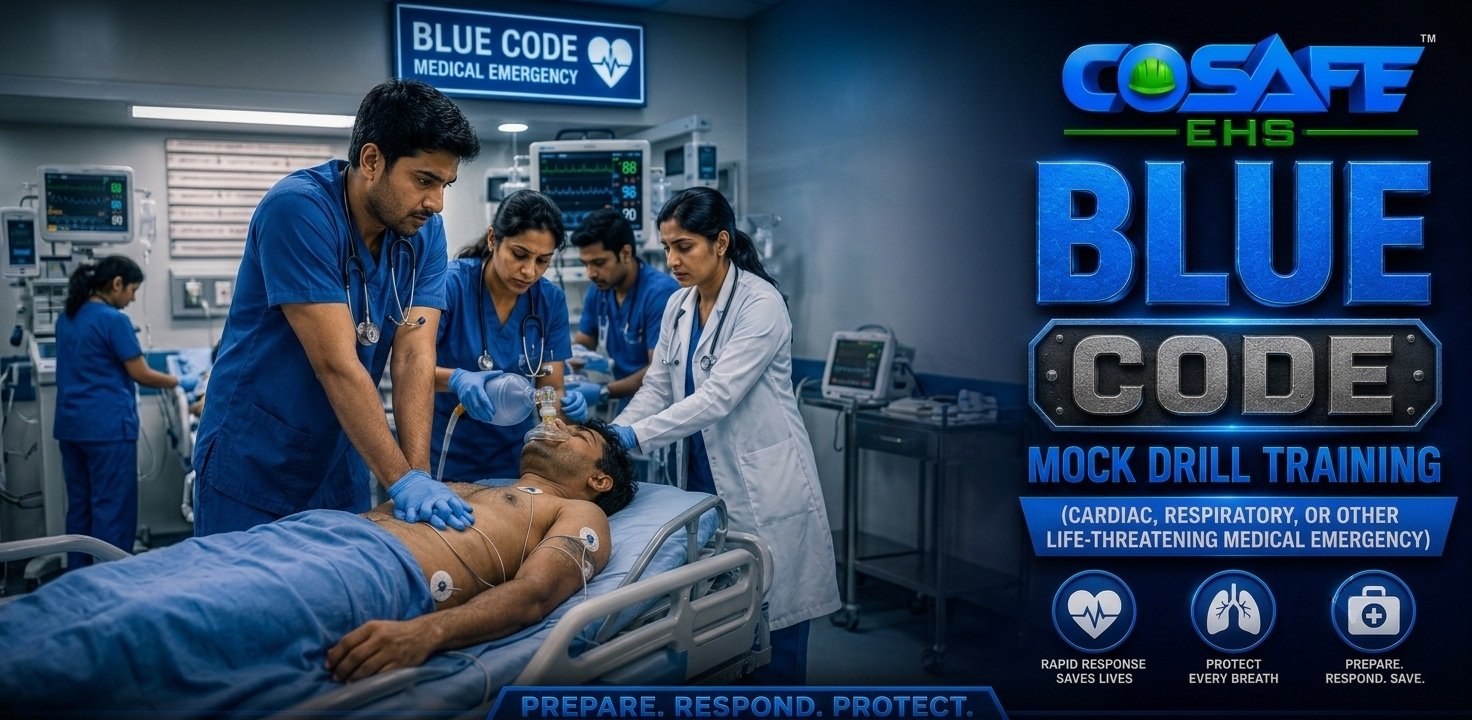
Blue Code Mock Drill Training

Overview

Professional Blue Code Mock Drill Training (Cardiac, Respiratory & Life-Threatening Medical Emergency) by Cosafe EHS Bangalore

Medical emergencies such as cardiac arrest, respiratory arrest, airway obstruction, unconsciousness, severe allergic reactions, shock, seizures, stroke, and other life-threatening conditions require immediate recognition, rapid activation of emergency response systems, and coordinated intervention by trained personnel. Every second is critical, and delays in response can significantly reduce survival rates while increasing the risk of permanent disability or fatality.

At Cosafe EHS Bangalore, our Blue Code Mock Drill Training (Cardiac, Respiratory & Other Life-Threatening Medical Emergency) is designed to strengthen emergency preparedness by providing healthcare professionals, Emergency Response Teams (ERT), industrial medical units, corporate first responders, educational institutions, and emergency coordinators with practical knowledge and simulation-based training for managing critical medical emergencies.

Through realistic emergency simulations, multidisciplinary coordination, Incident Command System (ICS), emergency communication protocols, patient stabilization awareness, cardiopulmonary resuscitation (CPR) support, automated external defibrillator (AED) awareness, emergency transport coordination, and structured mock drills, participants develop the confidence and competence required to manage life-threatening emergencies effectively.

The training follows internationally recognized emergency preparedness principles, occupational health and safety practices, hospital emergency management systems, and business continuity concepts to improve organizational readiness and patient safety.

What is a Blue Code?

A Blue Code (Code Blue) is one of the most widely recognized emergency alerts used in hospitals and healthcare facilities to indicate a cardiac arrest, respiratory arrest, or another life-threatening medical emergency requiring the immediate response of a specialized resuscitation or emergency medical team.

A Blue Code may be activated during:

  • Cardiac Arrest

  • Respiratory Arrest

  • Sudden Collapse

  • Airway Obstruction

  • Severe Breathing Difficulty

  • Unconscious Patient

  • Severe Allergic Reaction (Anaphylaxis)

  • Stroke Symptoms

  • Shock

  • Status Epilepticus (Prolonged Seizures)

  • Major Medical Emergency

  • Life-Threatening Trauma

  • Cardiac Rhythm Abnormalities

  • Medical Emergencies Requiring Immediate Resuscitation

The primary objective of a Blue Code is to rapidly mobilize trained responders, initiate immediate life-saving interventions, stabilize the patient, coordinate emergency resources, and ensure timely transfer for advanced medical care.

Countries Where Blue Code Systems Are Commonly Applied

Although emergency colour-code systems vary between organizations and countries, Code Blue is internationally recognized in many healthcare systems for cardiac or respiratory emergencies. It is commonly implemented across:

  • India

  • United States

  • Canada

  • United Kingdom

  • Australia

  • New Zealand

  • Singapore

  • Malaysia

  • United Arab Emirates (UAE)

  • Saudi Arabia

  • Qatar

  • Oman

  • South Africa

  • Ireland

  • Hong Kong

Many hospitals worldwide use Code Blue for cardiac arrest or respiratory arrest. However, emergency code policies may differ between organizations, and every facility should follow its approved Hospital Emergency Response Plan (HERP), Emergency Response Plan (ERP), and national healthcare regulations.

Why Blue Code Mock Drills are Important

Cardiac and respiratory emergencies can occur at any time without warning. Survival depends on immediate recognition, rapid emergency activation, early CPR, timely defibrillation where appropriate, coordinated teamwork, and efficient communication.

Without regular emergency drills, organizations may experience:

  • Delayed emergency activation

  • Slow response times

  • Communication breakdowns

  • Poor teamwork

  • Improper emergency equipment use

  • Delayed patient stabilization

  • Increased clinical risks

  • Regulatory non-compliance

  • Reduced survival outcomes


Regular Blue Code Mock Drill Training helps organizations:

  • Improve emergency preparedness

  • Strengthen emergency communication

  • Enhance multidisciplinary teamwork

  • Improve response time

  • Validate emergency response procedures

  • Increase responder confidence

  • Improve equipment readiness

  • Strengthen patient safety

  • Improve regulatory compliance

  • Support continuous quality improvement

Objectives of Blue Code Mock Drill Training

The program aims to:

  • Understand Blue Code activation procedures

  • Improve recognition of life-threatening emergencies

  • Strengthen emergency communication

  • Improve emergency leadership

  • Enhance CPR and AED awareness

  • Improve patient stabilization procedures

  • Strengthen multidisciplinary coordination

  • Validate emergency response plans

  • Improve emergency equipment readiness

  • Build organizational resilience

Who Should Attend?

This training is recommended for:

  • Hospital Administrators

  • Medical Superintendents

  • Emergency Physicians

  • Doctors

  • Nursing Officers

  • ICU & CCU Staff

  • Operation Theatre Teams

  • Emergency Department Personnel

  • Ambulance Teams

  • First Responders

  • Occupational Health Professionals

  • Industrial Medical Officers

  • EHS Managers

  • Safety Officers

  • Emergency Response Teams (ERT)

  • Security Personnel

  • Educational Institution Health Teams

  • Corporate Emergency Coordinators

Medical emergencies involving cardiac arrest, respiratory arrest, and other life-threatening conditions require immediate action, skilled teamwork, structured communication, and continuous preparedness. Regular Blue Code Mock Drill Training enables organizations to validate emergency procedures, improve response times, strengthen multidisciplinary coordination, and enhance patient survival outcomes.

At Cosafe EHS Bangalore, our Blue Code Mock Drill Training (Cardiac, Respiratory & Other Life-Threatening Medical Emergency) equips healthcare professionals, emergency responders, and organizations with the knowledge, practical skills, and confidence required to respond effectively during critical medical emergencies. Through realistic simulations, structured evaluations, and internationally aligned emergency preparedness practices, we help organizations build safer healthcare environments, stronger emergency response systems, and a culture of excellence in life-saving care.

Training Modules

Module 1: Introduction to Blue Code Emergency Management


Overview of Blue Code systems, emergency preparedness, patient safety principles, legal responsibilities, emergency response protocols, and organizational emergency management.


Module 2: Recognition of Life-Threatening Medical Emergencies


Identification of cardiac arrest, respiratory arrest, unconsciousness, stroke symptoms, severe allergic reactions, airway obstruction, shock, seizures, and other critical medical conditions.


Module 3: Blue Code Activation Procedures


Emergency activation criteria, emergency communication systems, emergency announcements, escalation procedures, documentation, and response timelines.


Module 4: CPR & AED Awareness


Understanding the principles of Basic Life Support (BLS), CPR sequence, AED awareness, responder safety, and coordination until advanced medical teams arrive.


Module 5: Airway and Respiratory Emergency Awareness


Recognition of airway obstruction, respiratory distress, oxygen emergencies, ventilation support awareness, and emergency airway management principles.


Module 6: Incident Command System (ICS)


Emergency leadership, command structure, resource management, communication hierarchy, documentation, and multidisciplinary coordination during medical emergencies.


Module 7: Emergency Equipment Readiness


Crash cart awareness, emergency medications, oxygen systems, suction equipment, monitoring devices, defibrillators, and emergency equipment inspection.


Module 8: Emergency Patient Transport


Safe patient movement, stretcher handling, ambulance coordination, transfer documentation, referral procedures, and continuity of care.


Module 9: Multidisciplinary Team Coordination


Coordination between physicians, nurses, emergency responders, laboratory services, pharmacy, biomedical engineering, administration, and ambulance personnel.


Module 10: Full-Scale Blue Code Mock Drill


Participants perform realistic emergency simulations involving Blue Code activation, emergency communication, patient assessment, multidisciplinary response, equipment deployment, documentation, and post-emergency coordination.


Training Methodology

  • Instructor-Led Classroom Training – Comprehensive sessions covering Blue Code principles, emergency response systems, emergency communication protocols, Incident Command System (ICS), patient safety, emergency leadership, and organizational emergency preparedness.
  • Interactive Learning Sessions – Facilitated discussions, real-world case studies, and emergency planning workshops to build a strong understanding of cardiac, respiratory, and other life-threatening medical emergencies.
  • Tabletop Emergency Exercises – Structured tabletop simulations enabling participants to evaluate realistic emergency scenarios, practice rapid decision-making, improve teamwork, strengthen communication, and coordinate multidisciplinary response activities.
  • Realistic Scenario-Based Simulations – Practical emergency simulations involving cardiac arrest, respiratory emergencies, medical emergencies, emergency code activation, patient stabilization, multidisciplinary coordination, and emergency response management.
  • Practical Demonstrations – Hands-on demonstrations covering crash cart operations, Automated External Defibrillator (AED) usage, oxygen delivery systems, emergency communication devices, patient transport procedures, and emergency medical equipment readiness.
  • Incident Command System (ICS) Implementation – Practical application of the Incident Command System, including emergency leadership, command structure, role allocation, operational coordination, resource management, and emergency decision-making during Blue Code incidents.
  • Full-Scale Blue Code Mock Drill – Live emergency simulation where participants activate Blue Code procedures, coordinate multidisciplinary emergency response teams, manage patient stabilization, implement emergency communication protocols, document response activities, and evaluate overall emergency response effectiveness.
  • Emergency Response Performance Evaluation – Assessment of response times, communication effectiveness, teamwork, equipment readiness, patient management, protocol compliance, leadership performance, and overall emergency preparedness.
  • Structured Debriefing & After-Action Review – Comprehensive post-drill debriefing to evaluate operational performance, identify strengths and improvement areas, review lessons learned, and recommend corrective actions for enhanced emergency response capabilities.
  • Corrective Action & Continuous Improvement – Detailed post-drill evaluation reports with practical recommendations to strengthen emergency response procedures, patient safety systems, medical emergency preparedness, and organizational resilience.
  • Competency Assessment – Participants are evaluated through written assessments, practical demonstrations, emergency simulations, scenario-based exercises, teamwork performance, and active participation throughout the training program.
  • Certification – Participants who successfully complete the program receive a Cosafe EHS Blue Code Mock Drill Training Certificate, recognizing their competency in Cardiac, Respiratory, and Life-Threatening Medical Emergency Preparedness & Response.

Why Choose Cosafe EHS Bangalore?


  • Experienced Healthcare & Emergency Response Consultants
  • Practical Scenario-Based Emergency Simulations
  • Competency-Based Learning Approach
  • Incident Command System (ICS) Integration
  • Customized On-Site Mock Drills
  • Comprehensive Emergency Response Evaluation
  • Detailed Post-Drill Assessment Reports
  • Compliance with International Emergency Preparedness Best Practices
  • Continuous Improvement Recommendations
  • Commitment to Building Safer, Emergency-Ready Organizations

Program Details