Bangalore Office
Warehouse No 4, Survey No 198/6, Janatha Colony, Dommsandra Bangalore Karnataka 562125
Warehouse No 4, Survey No 198/6, Janatha Colony, Dommsandra Bangalore Karnataka 562125
Godown No 3/C, Survey No. 217, Beside ORR, Shamshabad, R.R. District, Hyderabad, Telangana - 501218
+91 7892978960
corporate@cosafe.in
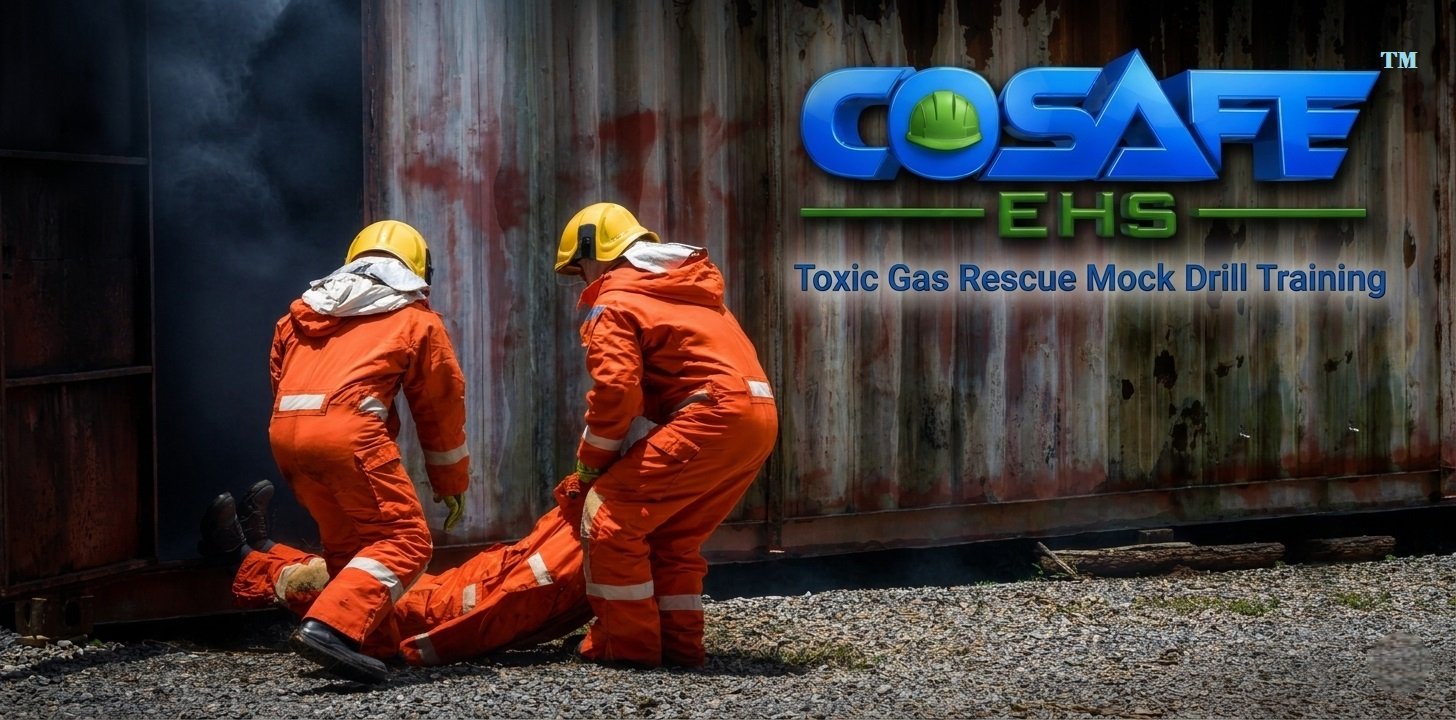
Toxic gas incidents are among the most dangerous industrial emergencies, capable of causing multiple casualties within minutes. Industries such as oil & gas, petrochemicals, chemical manufacturing, pharmaceuticals, refineries, wastewater treatment plants, mining operations, fertilizer plants, and process industries face the constant risk of accidental toxic gas releases. Common hazardous gases include Hydrogen Sulfide (H₂S), Ammonia (NH₃), Chlorine (Cl₂), Sulfur Dioxide (SO₂), Carbon Monoxide (CO), and Hydrogen Cyanide (HCN).
Unlike many workplace hazards, toxic gases are often invisible, fast-acting, and capable of affecting workers before they realize they are in danger. Certain gases can cause respiratory failure, unconsciousness, asphyxiation, and death within a very short period. Hydrogen Sulfide (H₂S), for example, is classified as an Immediately Dangerous to Life or Health (IDLH) hazard at 100 ppm and can cause rapid collapse at higher concentrations.
At Cosafe EHS Bangalore, our Toxic Gas Rescue Mock Drill Training Program is specifically designed to prepare Emergency Response Teams (ERT), rescue personnel, safety officers, plant operators, and emergency coordinators to effectively manage toxic gas emergencies. The program combines hazard recognition, gas detection, respiratory protection, rescue planning, casualty recovery techniques, emergency communication, incident command systems, and realistic rescue simulations.
Our training focuses on building practical rescue capabilities, strengthening emergency preparedness, reducing response times, and ensuring personnel can safely respond to toxic gas emergencies without becoming secondary victims themselves.
Many fatalities during toxic gas incidents occur not only among victims but also among untrained rescuers attempting emergency rescue without proper protection. Rescue personnel entering hazardous atmospheres without respiratory protection are at significant risk of becoming casualties themselves. OSHA and emergency response guidance emphasize the need for trained rescuers, proper respiratory protection, rescue planning, and regular drills.
Common Toxic Gas Hazards in Industry
Organizations may encounter:
Toxic process gases
This training is highly recommended for:
Organizations benefit through:
This program is suitable for:
At Cosafe EHS Bangalore, our Toxic Gas Rescue Mock Drill Training is customized according to site-specific hazards, toxic gas inventories, emergency response requirements, and industry risks.
Toxic gas emergencies can escalate rapidly, often leaving little time for decision-making. Without proper planning, training, gas monitoring, respiratory protection, and rescue preparedness, these incidents can result in severe injuries, fatalities, environmental damage, and operational disruption. Many toxic gas fatalities occur because rescuers enter hazardous atmospheres without proper protection or training.
At Cosafe EHS Bangalore, our Toxic Gas Rescue Mock Drill Training Program equips Emergency Response Teams, safety professionals, plant operators, and rescue personnel with the practical knowledge, technical skills, and confidence required to manage toxic gas emergencies safely and effectively. Through realistic simulations, hands-on rescue exercises, and expert-led instruction, we help organizations build a stronger emergency response capability and protect lives.
Detect the Hazard. Execute the Rescue. Save Lives. Choose Cosafe EHS Bangalore for Professional Toxic Gas Rescue Mock Drill Training in Bangalore.
Participants gain a comprehensive understanding of toxic gas hazards and emergency response requirements.
Topics include:
Participants develop awareness of the unique challenges associated with toxic gas emergencies.
Understanding gas hazards is the first step toward effective emergency response.
Participants learn how toxic gases affect people, equipment, and operations.
H₂S is one of the most dangerous industrial toxic gases.
Topics include:
Participants learn that smell should never be relied upon as a warning system because H₂S can rapidly impair the sense of smell.
Gas detection systems play a critical role in emergency response.
Training includes:
Participants learn how gas monitoring supports emergency decision-making.
Proper respiratory protection is essential during toxic gas emergencies.
Topics include:
Participants learn why positive-pressure SCBA is required for high-risk toxic gas rescue operations.
A well-developed emergency plan improves rescue effectiveness.
Topics include:
Participants understand how emergency plans support rapid response.
Effective command and control improves emergency outcomes.
Training includes:
Participants learn how emergency operations are managed during toxic gas incidents.
Clear role allocation improves rescue efficiency.
Topics include:
Participants understand their specific responsibilities during rescue operations.
Toxic gas emergencies often require rapid victim recovery.
Training includes:
Participants develop practical rescue competencies.
Specialized equipment supports safe rescue operations.
Topics include:
Participants become familiar with critical rescue equipment.
Effective evacuation reduces exposure risks.
Training includes:
Participants learn how to safely manage personnel during gas emergencies.
Proper casualty care improves survival outcomes.
Topics include:
Participants understand the importance of immediate medical intervention following toxic gas exposure.
Participants engage in realistic rescue simulations.
Activities include:
Participants gain practical emergency response experience.
Different emergency situations are introduced.
Exercises include:
Participants improve decision-making and adaptability.
Continuous improvement strengthens emergency preparedness.
Topics include:
Participants learn how organizations improve rescue readiness through regular drills.
At Cosafe EHS Bangalore, our Toxic Gas Rescue Mock Drill Training follows a highly practical, hands-on, and competency-based learning approach designed to replicate real industrial emergency situations.
Interactive Classroom Sessions
Participants receive structured instruction through:
This establishes a strong theoretical foundation.
Site Hazard Assessment
Before practical exercises, our experts conduct:
This ensures realistic and site-specific training.
Practical Equipment Demonstrations
Participants receive demonstrations covering:
Hands-on learning improves equipment competency.
Gas Monitoring and Detection Exercises
Participants perform:
These exercises strengthen hazard recognition skills.
Full-Scale Toxic Gas Rescue Mock Drills
The core of the training involves realistic rescue simulations.
Activities include:
Participants practice under realistic emergency conditions.
Scenario-Based Emergency Simulations
Real-world scenarios improve emergency response competency.
Exercises include:
This approach develops practical problem-solving skills.
Post-Drill Debriefing and Performance Evaluation
Following each exercise, participants receive:
This process supports continuous improvement.
Competency Assessment and Certification
Participants are evaluated through:
Certificates are awarded upon successful completion of the training program.
Details Information
Training Duration:- 1 Day / 2 Days
Mode of Training:- Classroom + Practical
Certification:- Certificate Provided
Certificate Validity:- 1–2 Years
Training Location:- Onsite / Training Center
Languages Available:- Kannada / Hindi / English / Telugu