






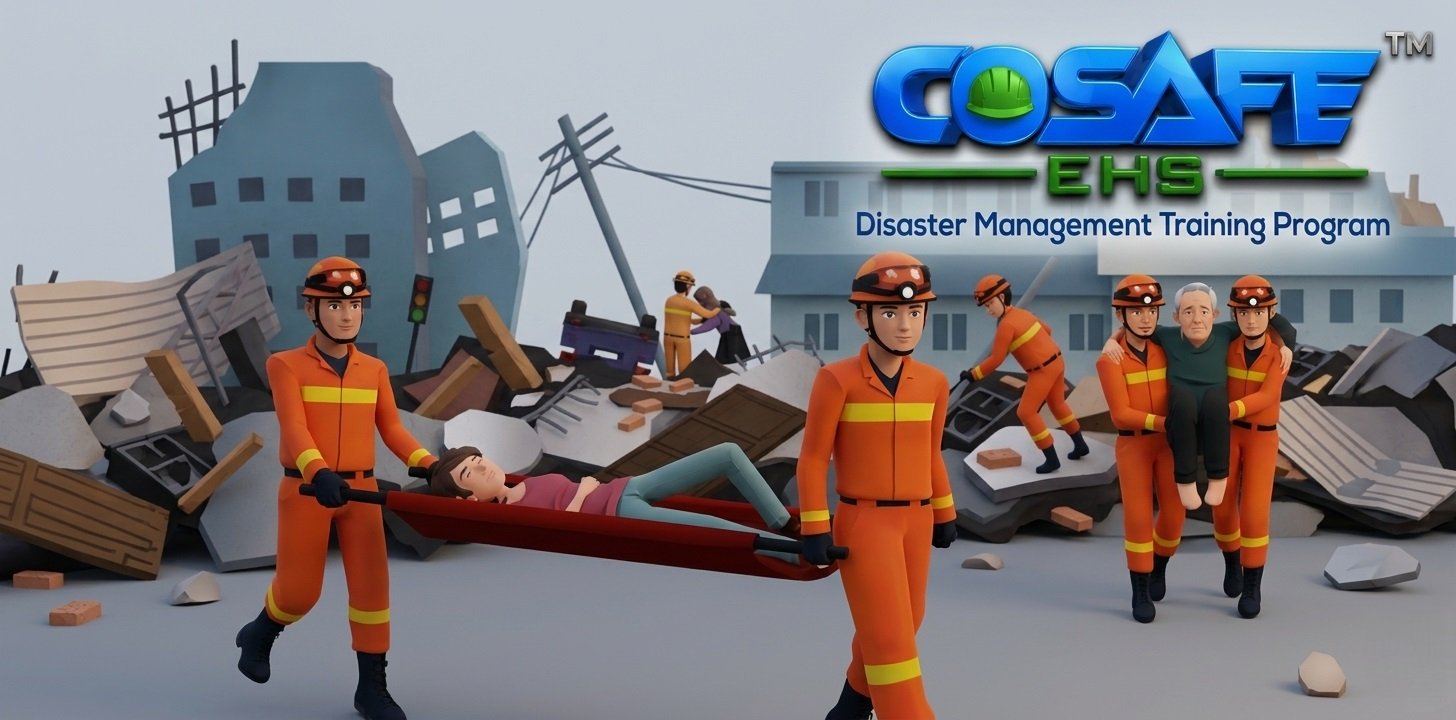
Overview
Disaster Management Training Program in Bangalore
Natural disasters, industrial accidents, fire incidents, chemical leaks, structural failures, floods, earthquakes, explosions, pandemics, and other emergency situations can severely impact human life, workplace safety, infrastructure, operations, and business continuity. Organizations today face increasing pressure to strengthen emergency preparedness, improve crisis response capability, and develop resilient systems capable of handling unexpected disasters effectively.
At Cosafe EHS Bangalore, we provide comprehensive and industry-focused Disaster Management Training Programs designed to help organizations prepare for, respond to, recover from, and mitigate the impact of various disasters and emergencies. Our programs equip employees, EHS professionals, emergency response teams, supervisors, facility managers, and organizational leaders with the practical knowledge, emergency coordination skills, and disaster response strategies required to manage critical situations effectively. (cosafe.in)
Disaster Management Training is an essential part of modern workplace safety, risk management, and business continuity planning. Effective disaster preparedness not only protects employees and assets but also helps organizations reduce downtime, maintain operational stability, and comply with occupational safety and emergency preparedness requirements.
The increasing frequency of industrial accidents, urban fire emergencies, climate-related disasters, and workplace incidents has made disaster preparedness a critical organizational priority across industries. Emergency preparedness discussions and safety professionals continue to emphasize the importance of structured disaster management systems, mock drills, emergency response coordination, and workforce awareness training to minimize disaster-related risks. (reddit.com)
At Cosafe EHS Bangalore, our Disaster Management Training Programs combine theoretical learning with practical emergency simulations, mock drills, incident command exercises, evacuation planning, rescue awareness, and crisis management training. We focus on real-world emergency preparedness and operational readiness to ensure participants can respond confidently during emergencies.
Cosafe EHS Disaster Management Training Programs are ideal for:
Manufacturing industries
Construction & infrastructure companies
Oil & gas industries
Warehouses & logistics facilities
Corporate offices & IT parks
Hospitals & healthcare facilities
Educational institutions
Hotels & hospitality sector
Shopping malls & commercial buildings
Facility management companies
Government and public sector organizations
Emergency response teams (ERT)
Organizations that invest in structured disaster management training improve resilience, strengthen emergency preparedness, reduce operational disruptions, and create safer workplaces capable of responding effectively during critical incidents.
Disasters and emergencies can occur without warning, but organizations that invest in disaster preparedness, emergency planning, and workforce training are significantly better equipped to minimize risks, protect lives, and maintain operational continuity.
At Cosafe EHS Bangalore, our Disaster Management Training Programs empower organizations with practical emergency response skills, crisis management strategies, disaster preparedness capability, and operational resilience required to build safer and more prepared workplaces. (cosafe.in)
Prepare for Emergencies. Strengthen Disaster Resilience. Build Safer Workplaces with Cosafe EHS Bangalore.
Training Modules
1. Introduction to Disaster Management
This foundational module introduces participants to disaster management principles and emergency preparedness systems.
Topics covered include:
Understanding disasters and emergencies
Types of natural and man-made disasters
Disaster risk and vulnerability concepts
Importance of disaster preparedness
Disaster management lifecycle
Organizational roles during emergencies
Participants gain a strong understanding of how proactive planning reduces disaster impact and improves response efficiency.
2. Hazard Identification & Risk Assessment (HIRA)
Disaster preparedness begins with identifying workplace hazards and operational vulnerabilities.
This module includes:
Hazard identification techniques
Workplace and environmental risk assessment
Fire, chemical, electrical, and structural hazards
Natural disaster vulnerability analysis
Risk prioritization methods
Preventive and mitigation strategies
Participants learn how systematic risk assessment improves emergency preparedness and operational safety.
3. Emergency Preparedness Planning
An effective disaster management system requires structured emergency planning.
Training includes:
Emergency preparedness plan development
Disaster response procedures
Resource allocation planning
Emergency communication systems
Business continuity awareness
Incident escalation procedures
Participants understand how organized emergency planning strengthens crisis management capability.
4. Fire Safety & Emergency Response
Fire incidents remain one of the most common workplace emergencies.
Topics covered:
Fundamentals of fire science
Fire prevention measures
Fire extinguisher awareness and usage
Emergency firefighting response
Fire alarm systems and evacuation procedures
Fire drill coordination
Hands-on demonstrations improve participant confidence during fire emergencies.
5. Emergency Evacuation Procedures
Safe evacuation is critical during disaster situations.
Participants learn:
Emergency evacuation planning
Safe exit route management
Staircase and assembly point procedures
Occupancy accountability and headcount management
Crowd control techniques
Evacuation coordination during emergencies
This module improves organized evacuation and reduces panic during critical incidents.
6. Search, Rescue & Casualty Management
Disasters often require immediate rescue support before professional responders arrive.
Training includes:
Basic search and rescue techniques
Casualty movement methods
Stretcher handling awareness
Safe lifting techniques
Rescue coordination procedures
Emergency casualty stabilization
Practical rescue exercises improve teamwork and emergency response capability.
7. First Aid & Medical Emergency Response
Immediate medical support can save lives during emergencies.
Participants are trained in:
Primary casualty assessment
CPR and basic life support awareness
Bleeding and burn management
Fracture and trauma response
Medical emergency handling
Coordination with medical services
This module strengthens workplace medical preparedness during disaster situations.
8. Chemical Spill & Hazardous Material Response
Industries handling hazardous substances require specialized emergency preparedness.
Topics include:
Hazardous material identification
Chemical spill response procedures
Containment and isolation techniques
PPE usage during hazardous incidents
Decontamination basics
Emergency exposure response
Participants learn how to minimize risks during hazardous material emergencies.
9. Natural Disaster Preparedness
Organizations must prepare for environmental and climate-related emergencies.
Training includes:
Earthquake preparedness and response
Flood emergency management
Cyclone and severe weather awareness
Structural evacuation procedures
Disaster communication systems
Community and workplace resilience planning
Participants gain practical knowledge to respond safely during natural disasters.
10. Incident Command System (ICS) & Crisis Leadership
Structured emergency coordination improves disaster response efficiency.
Participants learn:
Incident Command System fundamentals
Roles of Incident Commander and emergency teams
Crisis leadership principles
Decision-making during emergencies
Communication hierarchy during disasters
Coordination with external emergency agencies
This module is especially valuable for EHS teams, management personnel, and emergency coordinators.
11. Business Continuity & Recovery Planning
Disaster management also focuses on minimizing operational disruption.
Topics covered:
Business continuity planning awareness
Critical operation identification
Data and infrastructure protection
Recovery planning basics
Operational restoration procedures
Post-incident recovery coordination
Organizations learn how to maintain operational stability during and after disasters.
12. Mock Drills & Disaster Simulations
Practical simulations are one of the most important parts of effective disaster management training.
Activities include:
Fire and evacuation drills
Earthquake response simulations
Chemical spill emergency exercises
Casualty rescue demonstrations
Incident command simulations
Multi-team emergency coordination exercises
Disaster response evaluation drills
Mock drills help organizations assess preparedness levels and identify improvement opportunities.
Training Methodology
At Cosafe EHS Bangalore, we follow a highly practical, industry-oriented, and scenario-based training methodology designed to maximize disaster preparedness and emergency response capability. Our programs are delivered by experienced EHS professionals, industrial safety trainers, emergency management specialists, and crisis response experts with practical operational experience. (cosafe.in)
Interactive Classroom Sessions
Participants receive structured theoretical learning through:
- Visual presentations
- Real-life disaster case studies
- Industrial emergency analysis
- Safety workshops and discussions
- Crisis management videos
- Interactive group learning activities
This helps participants clearly understand disaster management systems and emergency response strategies.
Practical Emergency Demonstrations
Practical learning is the core of our Disaster Management Training Programs.
Participants receive demonstrations on:
- Firefighting equipment usage
- Emergency evacuation procedures
- PPE and rescue equipment awareness
- First aid and casualty handling
- Spill response equipment operation
- Emergency communication systems
Hands-on exposure improves participant confidence and emergency readiness.
Scenario-Based Disaster Simulations
We conduct realistic emergency simulations based on workplace risks and industry hazards.
Simulation activities include:
- Industrial fire emergencies
- Earthquake evacuation exercises
- Chemical spill response scenarios
- Rescue and casualty handling drills
- Emergency communication testing
- Multi-department crisis coordination
This practical approach improves decision-making, teamwork, and emergency response performance.
Team-Based Emergency Coordination Exercises
Effective disaster response requires coordination between multiple teams and departments.
Our methodology includes:
- Emergency response role allocation
- Incident command exercises
- Leadership during emergencies
- Team communication drills
- Cross-functional emergency coordination
- Crisis response planning activities
Participants learn how structured teamwork improves disaster management efficiency.
Mock Drills & Real-Time Emergency Exercises
Practical drills are conducted to evaluate workforce preparedness and emergency readiness.
Exercises include:
- Emergency evacuation drills
- Fire response simulations
- Rescue coordination exercises
- Disaster response timing analysis
- Assembly point management
- Communication effectiveness assessment
Detailed post-drill feedback and corrective recommendations are provided after every exercise.
Assessment & Competency Evaluation
Participants are assessed through:
- Practical emergency response demonstrations
- Written evaluations and quizzes
- Scenario-based participation reviews
- Disaster management exercises
- Team coordination assessments
- Interactive Q&A sessions
Certificates are issued upon successful completion of the training program.
Why Choose Cosafe EHS Bangalore for Disaster Management Training?
- Industry-focused practical disaster management training
- Experienced EHS and emergency response trainers
- Customized training based on workplace risk profile
- Realistic mock drills and disaster simulations
- Compliance-focused safety and preparedness programs
- Hands-on rescue and emergency response exercises
- Multi-industry expertise in workplace safety training
- On-site and classroom training options
- Strong focus on crisis preparedness and operational resilience
Cosafe EHS Bangalore is committed to helping organizations strengthen disaster preparedness, improve workforce safety, and build resilient emergency response systems through professional EHS and disaster management training solutions. (cosafe.in)
Industries We Serve
- Our Disaster Management Training Programs are suitable for:
- Manufacturing Industries
- Construction & Infrastructure Projects
- Oil & Gas Industries
- Warehousing & Logistics Companies
- Corporate Offices & IT Parks
- Hospitals & Healthcare Facilities
- Educational Institutions
- Hotels & Hospitality Sector
- Shopping Malls & Commercial Buildings
- Facility Management Companies
- Engineering & Process Industries
Program Details
Duration: Half Day (3–4 Hours) / Full Day (5–6 Hours)
Certification: Certificate will be provided after successful completion
Validity: 1–2 Years
Languages: Kannada / Hindi / English / Telugu