






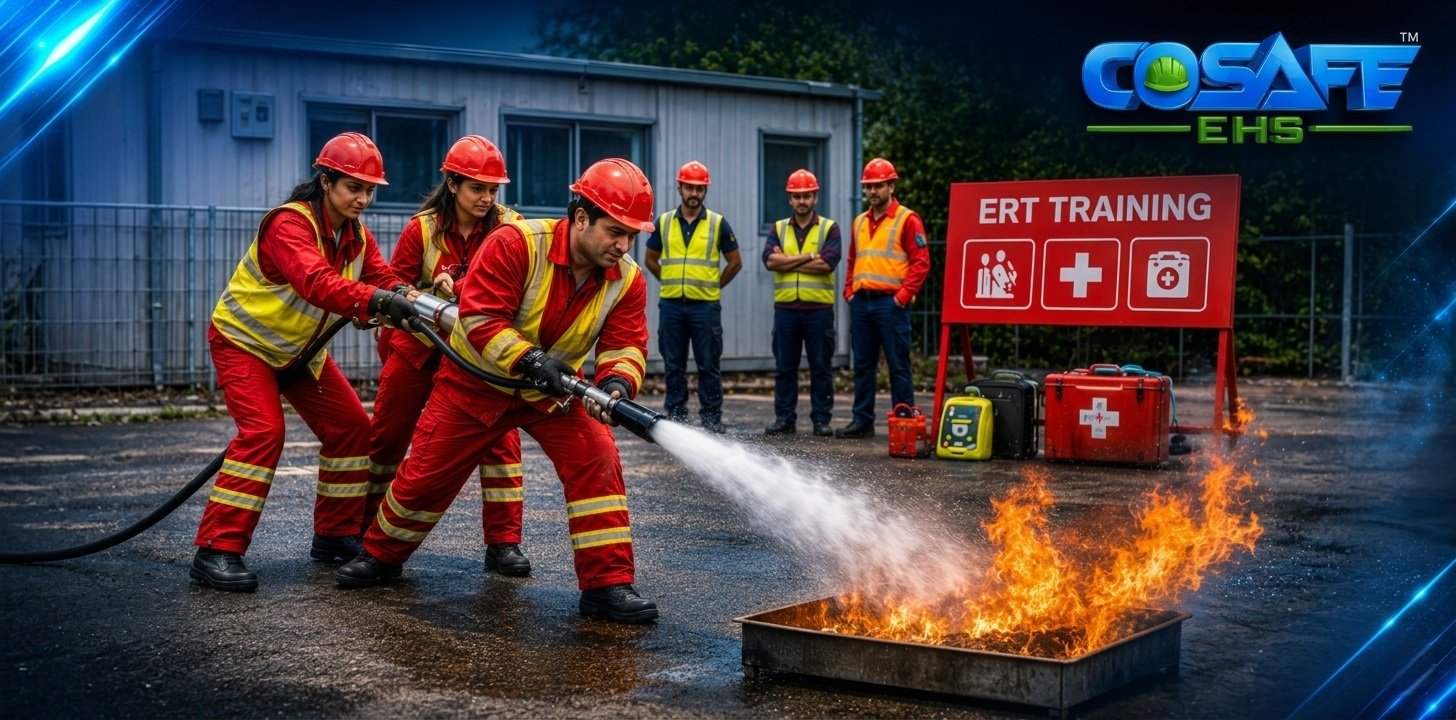
Overview
Why Emergency Response Team (ERT) Training is Essential
Emergencies can arise without warning in workplaces, industrial facilities, commercial establishments, educational institutions, and public environments. In such critical moments, the ability to respond quickly, efficiently, and confidently can make the difference between controlled situations and major disasters.
This is why Emergency Response Team (ERT) Training is not just important—it is essential. A well-trained ERT ensures immediate action during emergencies, minimizing risks to life, property, and business operations.
What is an Emergency Response Team (ERT)?
An Emergency Response Team (ERT) is a group of trained employees or designated personnel within an organization responsible for managing and responding to various emergency situations.
Their key responsibilities include:
Identifying and assessing workplace hazards and risks
Responding promptly to emergencies such as fire outbreaks, medical incidents, chemical spills, and industrial accidents
Providing first aid and immediate assistance before external responders arrive
Supporting evacuation procedures and managing crowd control
Coordinating with external emergency services like fire departments, hospitals, and disaster management authorities
A well-structured ERT plays a critical role in reducing injuries, preventing property damage, minimizing downtime, and saving lives.
Cosafe EHS ERT Training Approach
At Cosafe EHS Banglore, we deliver specialized Emergency Response Team (ERT) Training programs designed to build a highly skilled and responsive workforce.
Our training focuses on:
Practical emergency handling skills
Fire safety and firefighting techniques
First aid and medical emergency response
Industrial and workplace hazard management
Leadership and decision-making under pressure
With extensive expertise in industrial safety and emergency preparedness, we ensure that your team is fully equipped to act decisively in real-life emergency situations.
Emergencies are unpredictable, but preparedness is a choice. Organizations that invest in building a competent Emergency Response Team create a safer, more resilient work environment.
Our ERT Training program empowers your workforce with the knowledge, skills, and confidence to handle emergencies of any scale—whether it’s a fire incident, medical emergency, or industrial hazard.
By choosing Cosafe EHS Bangalore, you are not only meeting compliance requirements but also safeguarding your people, protecting your assets, and ensuring business continuity.
Why Choose Cosafe EHS Bangalore?
Choosing the right training partner ensures your investment in safety is worthwhile. At Cosafe EHS Bangalore:
We combine global safety standards with localized risk solutions.
We emphasize practical training over just theoretical knowledge.
We provide post-training support and refresher sessions.
We aim to build a strong safety culture within organizations.
Prepare your team today. Respond with confidence tomorrow.
Training Modules
Emergency Response Team (ERT) Course Objectives
At Cosafe EHS Bangalore, our Emergency Response Team (ERT) Training program is designed with clear, practical, and industry-focused objectives to build a competent and confident emergency response workforce.
The key objectives of this training are:
To provide in-depth knowledge of fire safety, evacuation procedures, and first aid practices
To train participants in effective search, rescue, and casualty handling techniques
To enhance decision-making, teamwork, and leadership skills during emergency situations
To ensure proper understanding and hands-on use of firefighting equipment, breathing apparatus, and safety gear
To promote a proactive safety culture and risk awareness across the organization
Key Training Modules
Our ERT Training program at Cosafe EHS Bangalore is structured to cover all critical aspects of emergency preparedness and response. The modules are flexible and can be customized based on industry type, operational risks, and specific client requirements.
1. Introduction to Emergency Preparedness
Overview of emergencies and disaster scenarios
Types of workplace emergencies: fire, chemical, electrical, medical, and natural disasters
Roles and responsibilities of Emergency Response Team members
2. Fire Safety & Firefighting Techniques
Fundamentals of fire science and fire behavior
Classes of fire and appropriate extinguishing methods
Identification and proper use of fire extinguishers
Practical firefighting drills using hydrants, hoses, and extinguishers
3. Evacuation Planning & Emergency Communication
Designing effective evacuation plans and escape routes
Assembly points and headcount procedures
Communication strategies during emergencies
Managing panic situations and crowd control
4. Search & Rescue Operations
Rescue planning in confined spaces and hazardous environments
Safe techniques for lifting and moving injured persons
Use of rescue equipment such as ropes, stretchers, and tools
Safe entry procedures using Breathing Apparatus (BA)
5. First Aid & Basic Life Support (BLS)
Primary survey: Danger, Response, Airway, Breathing, Circulation (DRABC)
CPR (Cardiopulmonary Resuscitation) and AED usage
Treatment of wounds, fractures, burns, and bleeding
Managing medical emergencies such as heart attack, stroke, shock, and choking
6. Chemical Spill & Hazardous Material Response
Identification and classification of hazardous substances
Spill control, containment, and neutralization techniques
Proper use of Personal Protective Equipment (PPE)
Decontamination procedures and safety protocols
7. Incident Command System (ICS) & Leadership Skills
Structure and functions of the Incident Command System
Roles of Incident Commander, Team Leaders, and Response Teams
Decision-making and leadership during high-pressure situations
Coordination with external emergency services
8. Mock Drills & Scenario-Based Training
Simulated fire and evacuation drills
Industrial emergency and accident scenarios
Realistic medical emergency simulations
Performance evaluation and feedback for continuous improvement
Training Methodology
Training Methodology
At Cosafe EHS Bangalore, we follow a highly practical and hands-on training methodology designed to bridge the gap between theoretical knowledge and real-world emergency response.
Our approach includes:
Interactive classroom sessions supported by presentations, videos, and real-life case studies
Live demonstrations of firefighting equipment, rescue tools, and safety systems
Mock drills that simulate real emergency scenarios
Group discussions and team-building activities to enhance coordination
Performance evaluation through written assessments, practical drills, and scenario-based responses
This structured and engaging methodology ensures that participants not only understand emergency concepts but also develop the confidence and competence to respond effectively in critical situations.
General Guidelines for ERT Team Ratio
The required number of Emergency Response Team (ERT) members varies depending on industry type, risk level, and workforce size. However, the following benchmarks are widely accepted across industries:
- High-risk industries (oil & gas, chemical, mining, etc.):
1 ERT member for every 20–25 employees
- Moderate to low-risk workplaces (offices, warehouses, educational institutions):
1 ERT member for every 30–40 employees
- Fire safety norms (including India):
Minimum 10% of the total workforce should be trained as ERT members
- Shift-based operations:
The required ERT ratio must be maintained for each shift to ensure complete emergency coverage at all times
Implementing the right ERT ratio ensures faster response, better coordination, and improved safety outcomes during emergencies.
Legal & Compliance Requirements for ERT / Emergency Preparedness Program
To ensure full compliance with applicable safety regulations and standards in India, an effective Emergency Response Team (ERT) program should include the following components:
1. Legal Identification & Register
Organizations must identify all applicable safety, environmental, and emergency-related laws and maintain an updated legal register to ensure ongoing compliance.
2. Risk Assessment & Hazard Analysis
Conduct systematic assessments to identify potential hazards such as fire, chemical spills, structural failures, and medical emergencies. Define control and mitigation measures accordingly.
3. Emergency Response Plan
- Develop a comprehensive and documented emergency plan covering:
- Emergency activation procedures
- Roles and responsibilities
- Communication protocols
- Evacuation and rescue processes
- Medical response arrangements
- For high-risk industries, both on-site and off-site emergency plans are essential.
4. Formation of ERT & Incident Command Structure
- Establish a clear emergency hierarchy, including:
- Incident Commander
- Response Team Members
- Evacuation Marshals
- Communication Coordinators
- First Aid Responders
- Clearly define roles and responsibilities to ensure effective coordination during emergencies.
5. Training, Drills & Mock Exercises
Regular training programs and mock drills are critical for preparedness. As per regulatory requirements (such as the Factories Act), periodic emergency drills must be conducted and evaluated.
6. First Aid & Medical Preparedness
Ensure availability of first aid facilities and trained personnel at the workplace, in line with statutory requirements (e.g., Factories Act provisions).
7. Fire Safety Infrastructure
- Install and maintain essential fire safety systems, including:
- Fire extinguishers
- Fire alarms and detection systems
- Sprinkler systems
- Emergency exits and lighting
- Regular inspection and maintenance are mandatory to ensure readiness.
8. Communication & External Coordination
Establish effective communication channels and coordinate with external emergency services such as fire departments, hospitals, and local authorities.
9. Monitoring, Auditing & Review
Conduct periodic safety audits, inspections, and compliance reviews. Identify gaps and implement corrective actions, with involvement from top management.
10. Documentation & Reporting
- Maintain detailed records of:
- Training sessions
- Mock drills
- Incident reports
- Compliance checks
- Ensure timely reporting to regulatory authorities as required.
Program Details
Duration: 1 Day / 2 Days (Based on requirement)
Certification: Certificate provided upon successful completion
Validity: 1–2 Years
Languages: Kannada / Hindi / English / Telugu